Summer and Time for a Cleaning

As school gets out in early June, the time to start the maintenance routing begins. This all needs to get done before the Exeter Summer Session, a six week program that runs all of July and into the first two weeks of August. Checklist of To-Do items:

  • Wet clean all surfaces of the dome interior including the dome-to-structure interface (pollen and construction debris, spider webs, etc); walls; mount; telescope tube exterior; cables.
  • Remove any wasp nests and mud-doubed nest material.
  • Sweep out the debris on the floor, wet mop as needed.
  • Dry!
  • Micro-dust vacuum the optical tube interiors (open tube systems only).
  • Clean the optical surfaces.
  • Clean the eyepieces. These get really used hard and do not act favorably to eye makeup or DEET. Some get tossed, sadly, each year.
  • Replace lubricant on two of the mounts which get annual lube changes. We use Lubriplate 105 for the worm and drive gears on the Paramounts, per Software Bisque’s maintenance plans.
  • Replace any optical components that have given-in to New Hampshire weather conditions. Usually the V Photometric filters are first to go, as their glass recipe is reactive to high humidity and sea salt nuclei in the air. Being near sea level does not help.
  • Take new darks, biases and flat field frames.
  • Clean out any debris in the weather station.

This last year we replaced the rubber matting that seals the dome-to-structure interface, covering the rollers and the opening to the outside world. The original covering was thirty years old! The new material is a smooth surface and not porous like the previous covering. This makes for easier wet cleaning and faster drying.

The results? Clean operational status!
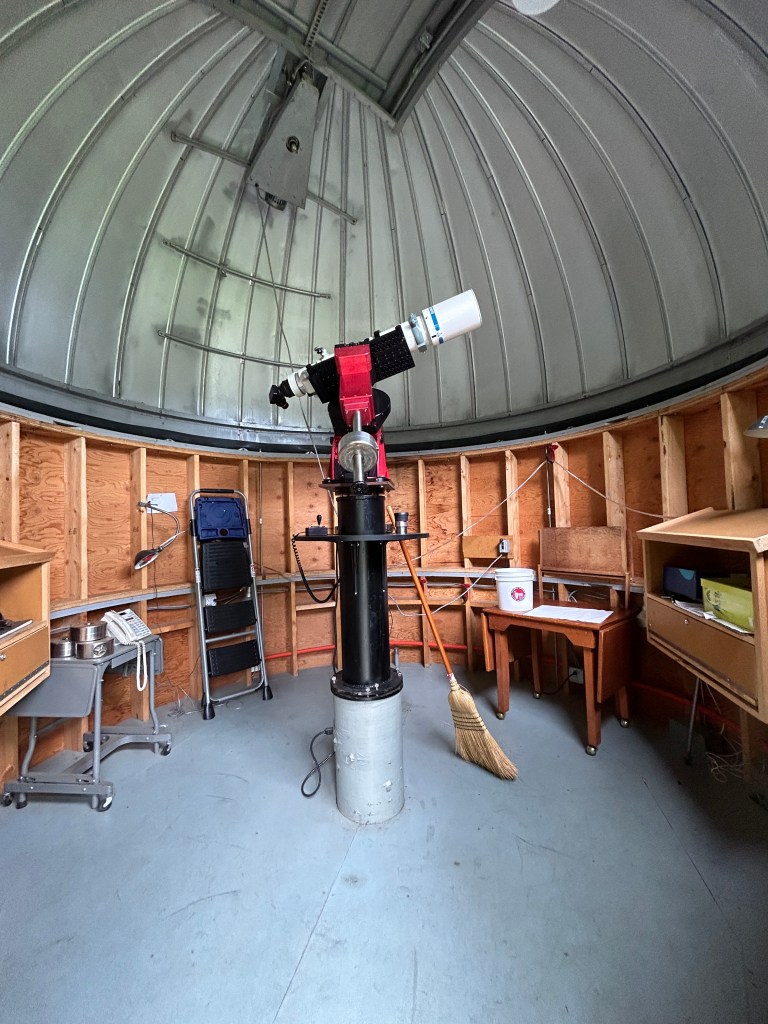
The Takahashi refractor for visual and wide-field photographic use.
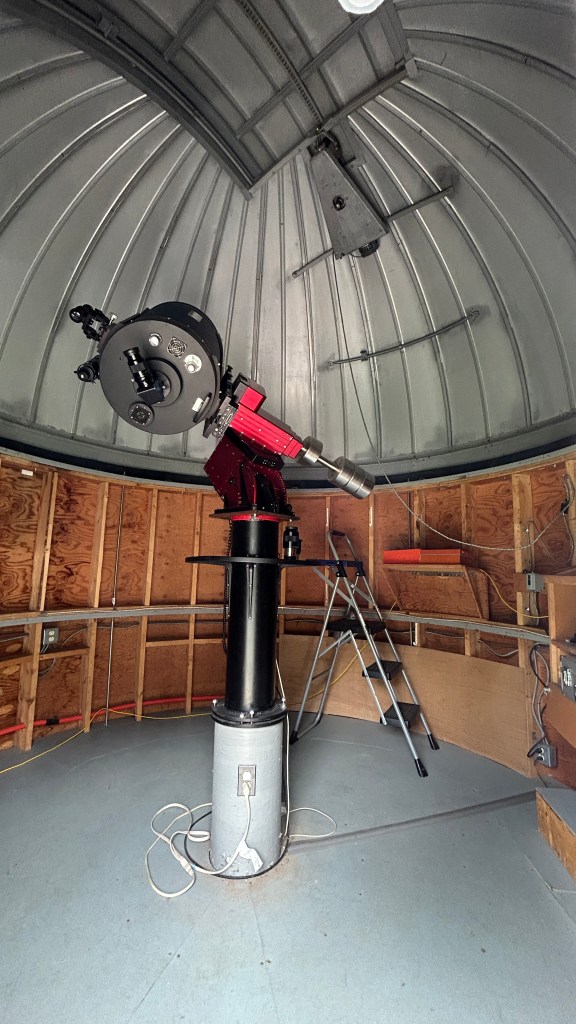
The 0.7m telescope with CCD and Spectrograph.
Kurtz Dome 16" Meade Flat Field SCT primarily for visual use.
Kurtz Dome 16″ Meade Flat Field SCT primarily for visual use.

Springtime Nova: V1716 SCO

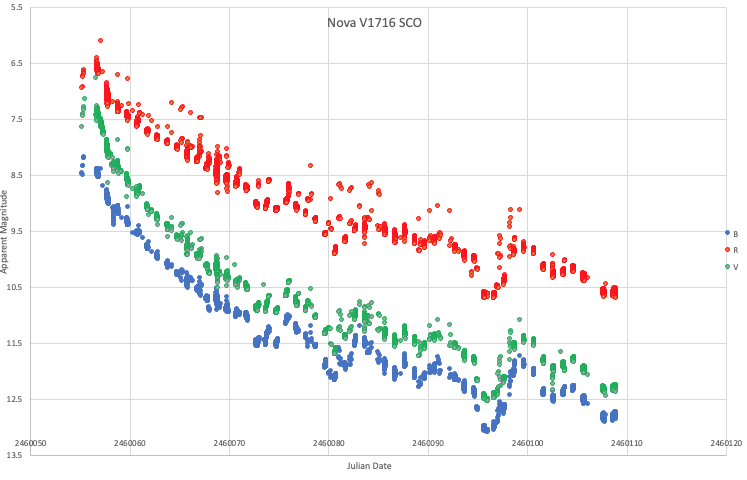
Advanced astronomy classes this spring had the opportunity to hone their skills at image data extraction and analysis with a telescope we have been operating in the southern hemisphere. This spring, a classical nova erupted, reaching V magnitude ~ 6.7 or so before fading. We collected data every clear night in photometric filters, V, B and R for analysis and submission to the AAVSO. When done, students had correctly analyzed 176 data points and submitted those as observer GPE (Grainger Phillips Exeter), our AAVSO initials. Below is a plot of the V, B and R data from the AAVSO which includes our data and those from all the other observers who took part in observing this star.

Light curve of AAVSO data for the nova V1716 SCO.

Apparent magnitudes in V, B and R are on the ordinate. Julian Date is on the abscissa. The colors denote filters used: Red = R, Green = V, and Blue = B photometric filters. We acknowledge with thanks the variable star observations from the AAVSO International Database contributed by observers worldwide and used in this research.

Supernova in M-101

This May we were in a fortunate situation: clear skies and a new supernova to observe. The advanced astronomy classes had the opportunity to reduce and analyze the data and feed their results to the AAVSO. Below is a 300 second lum-filter integration of the region of SN 2023ixf in Messier 101. At peak, this object reached an astounding magnitude in V ~ 10.8

Messier 101, the Pinwheel Galaxy, and the supernova are 20.9 million light-years distant. The supernova was confirmed as a Type II meaning it was once a very massive star which, at the end of its “life cycle” had expanded into a red supergiant and imploded resulting in the explosion phenomena you see here.