
There’s an eclipse tomorrow morning. From our location in Exeter, it will be in process as the sun rises. It is not a total eclipse from our location, but rather a partial eclipse. You’d have to be in Africa to see totality. Weather is not looking good at this time For more on the eclipse: http://en.wikipedia.org/wiki/Solar_eclipse_of_November_3,_2013 for more on the weather here: http://www.exeter.edu/astronomy/wx/Current_Vantage_Pro.htm
Category Education
Nova Del 2013
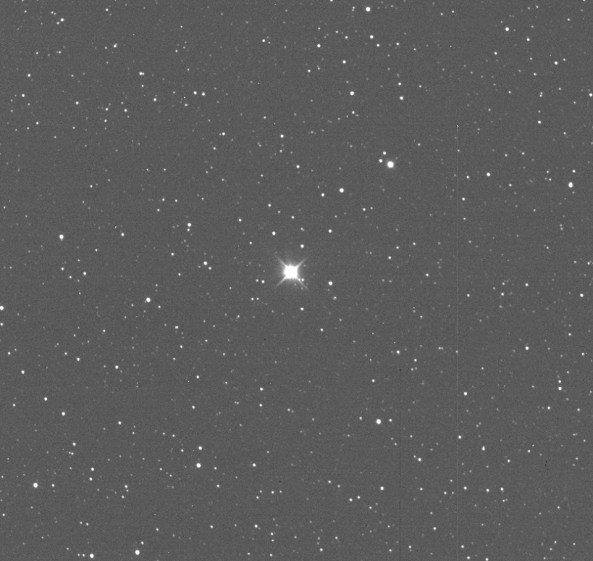
The nova has brightened enough that one can see it plainly without any optical aid. Our telescopes here at the school are no longer able to image the star without their cameras getting overwhelmed. Here is a 30 second exposure with the robotic observatory’s 10″ RC:
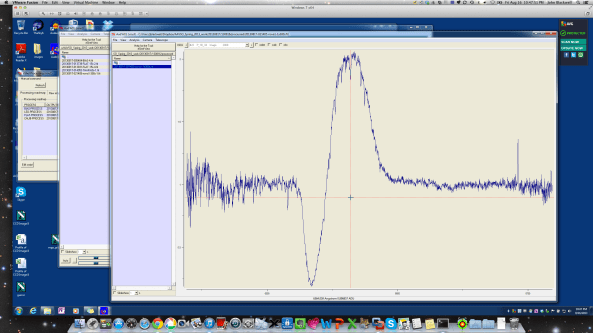
The star also is a prime candidate for small telescope spectroscopy, so I opened our Echelle spectrograph last night and grabbed high resolution from 400-700nm. Here is the H-alpha range. That is a nova alright!
Possible Nova in Delphinus
Some interesting astronomy events got a lot of people stirring last night. A potential nova has been discovered in the summer constellation Delphinus. The discovery goes to Koichi Itagaki of Yamagata, Japan, using 0.18-m reflector + unfiltered CCD. When I went out last night to check it out, it was plainly visible as something new and unexpected at the end of Sagitta (the Arrow) and to the north of Delphinus. Here’s a finder for you taken with a D7000. It’s a pretty wide field which would be ok for binoculars. Note the positions of the Coat Hanger asterism and Delphinus. It’s an easy find!

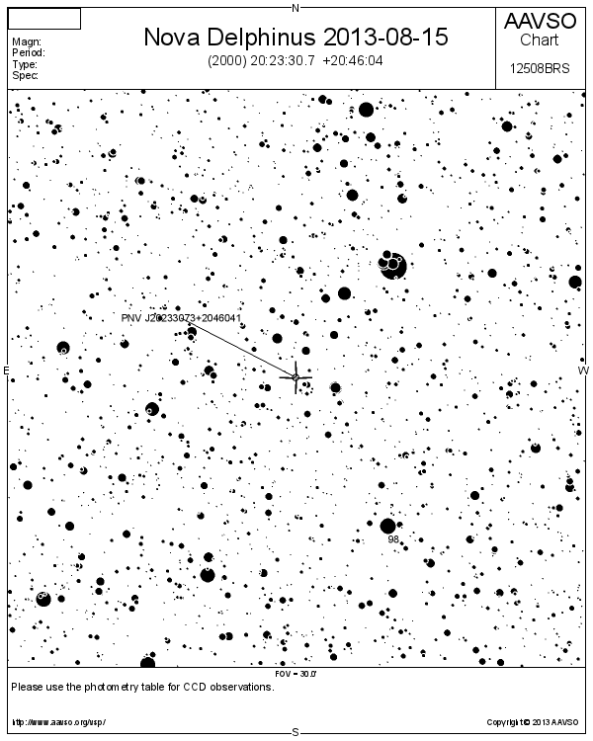
For a smaller field of view, you can go to the AAVSO website and make a plot of the area like this one which is on the 30′ scale for wide field CCDs like that in our Robotic Telescope at the Academy.
I was totally surprised to find the star getting brighter, so bright that in under an hour, I was unable to use a photometric filtered CCD to image it without maxing out the CCD. Oh well! Enjoy everyone, and clear skies to you!
A Week in Review: NITARP 2013
This has been a fine week for collaboration and discovery. This year our NITARP group contains three teachers, four including myself as the mentor teacher, and eleven students from four states: Tennessee, Wisconsin, New York, and Connecticut. Our project has been to utilize data from the GALEX (Galaxy Evolution Explorer) and SDSS (Sloan Digital Sky Survey) to determine correlations between Seyfert galaxy luminosities and their temperatures. Our abstract:
Data from the Sloan Digital Sky Survey (SDSS) and the Galaxy Evolution Explorer (GALEX) satellite will be used to extend the work of the 2010 and 2012 NITARP teams in demonstrating a hypothesized correlation between the luminosity and color (temperature) of the accretion disk within Type I Active Galactic Nuclei (AGN). The 2012 NITARP team was successful in finding a trend in the UV luminosity and color of the AGN in Type I quasars, however the sample size was not sufficient in demonstrating a substantial correlation. More data are needed to see if a more substantial correlation exists; therefore, data from less luminous AGN must be used. Our project will attempt to investigate whether a more significant trend is revealed when Type I Seyfert galaxies with redshifts 0.1 < z < 0.5 are added to the 2012 team’s quasar sample.
We spent this week pouring over the data and making our initial analysis of the MANY plots that we have generated. The group has achieved a notable synergy, which, I believe, comes from all being together for the week, largely in the same space, a large work area within the NASA IPAC building on the Caltech campus in Pasadena. When the day is in progress, the mutterings and discussions between people are just roll right along. At the end of the day, the work “ends” and relaxation mode begins. Some of the post-work activities this week have included some time at the beach, the end of Route 66 on Santa Monica Pier, touring through the main drags in Hollywood, visiting Old Pasadena, touring Caltech, and catching up with friends in the area. I love the Caltech canpus and have run into a couple of alumni here this week. The campus is in full glory with an 85F dry heat, sunny days and everything in bloom. That citrusy smell abounds with other flowers making themselves known: honeysuckle among them. The olive trees have just ripening dark fruit on their branches. Hummingbirds zip in and out of the many flowering trees and the yuccas.
Today is our last day: we aimed to get the students to mingle a bit more by working to finish off the various plots we need for analysis. We’re also aiming to wave at Saturn for the largest ever global scaled photobomb,,,, more on that here: http://saturn.jpl.nasa.gov/news/waveatsaturn/viewing/
‘Nuff said. See you all back in New Hampshire, soon enough!
June 2013 Exeter Astronomy Education Conference
It is that time again! I will be hosting another astronomy education conference starting this weekend! The weeklong meeting will allow astronomy educators from around the USA to discuss and try various methods of teaching modern astronomy and astrophysics. Topics that have been covered in detail in the past:
- CCD Imaging: photometry, color work, narrow band filters, astrometry, guiding, installation, design.
- Observatory design, construction and maintenance.
- Available software for astronomy, science, data reduction, learning and labs.
- Required topics in astronomy.
- Best practices in astronomy education, pretesting, post-testing, assessment.
- Teaching astronomy in difficult situations: limited budgets, light pollution, late nights out.
It is always a fun time, and generates a ton of communications following the event. This year, we are once again full. We even had a wait list! Stay tuned for more information as the week progresses.
May Annular Eclipse
This May also plays host to the annular solar eclipse on the 10th. This eclipse is visible from the north central portions of Australia eastwards into the equatorial regions of the Pacific Ocean. More information can be found in this graphic from NASA:

NASA Eclipse May 10 2013
eta Aquarid Meteor Shower
This May hosts another occurrence of the eta Aquarid shower. This shower often gives a reasonable 60 meteors per hour from dark sky locations. If you are in an urban area, then, well, you will not see many if any meteors at all. My highest recommendation is that you seek out a location at least a couple of hours away from major cities into dark country sites. Bring s comfortable lounge chair and some coffee, then spend the night looking up without any telescopes or binoculars. One common misconception is that you need a telescope to see showers. While there is a special area of study for telescopic meteors, most showers are just fine with the unaided eyeball as your instrument. More information about this particular shower here: http://www.spaceweather.com/meteors/etaaquarids/etaaquarids.html
Comet PanSTARRS at Last!
2013-March-13 gave us the opportunity to see Comet L4 PanSTARRS for the first time here in southern New Hampshire, so many of us astro-types went out, sought dark and high-altitude locations with good westerly views. I found mine with my family: on top of Stratham Hill Parks observation tower. It’s like an old fashioned fire tower, but without the booth on top. It has a roof, but that’s it, no walls. We got set up with a pair of binoculars a tripod and the Nikon D7000 at about 6:20PM. Sunset was at 6:47PM, so we had time to sit, chat, and watch as other like-minded folk came to witness the event.
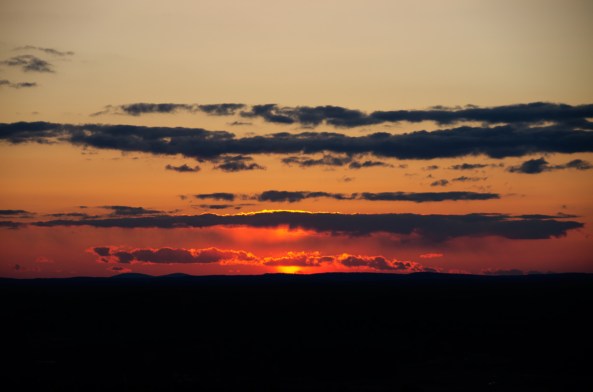
Sunset was lovely, and gave us a splendid view of some fracto-cumulus clouds off in the distance (Northwood) which were still expelling some rain as evaporating virga.
We were thinking that we’d be seeing the comet earlier and perhaps with binoculars, within minutes after the sun had set. No go. The comet was a fainter than expected. Not many people are making magnitude estimates of its brightness. We say about magnitude 0 or a little fainter is the right amount, as we didn’t see it for nearly another 30 minutes! When spotted (through our trusty 10x60s), it was hard to spot, then about 30% lower than the moon to the horizon. The moon was lovely: a waxing crescent with strong earthshine. The comet showed up well in photos though, so here is the wide field shot taken with a Nikon D7000 at 18mm. Look carefully and you’ll see the comet between the horizon and the moon.
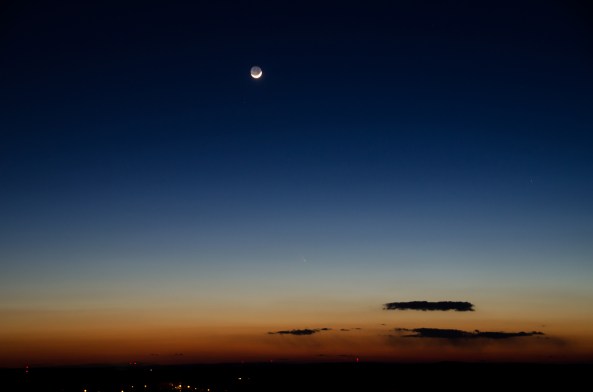
As if that was fun enough, we also ran into a former student (you know who you are!) who happened to be in the area wanting to seek out the comet with the rest of us. She had recognized my voice and climbed up to verify: “Is that Mr. Blackwell up there!?” 😉 Working to get a closer shot, we zoomed in a bit and were successful to a point. It turns out that focus on the D7000 with this 18-200mm lens is NOT very sharp when set to infinite. Comet should be at infinity, right? I mean, they are over 1AU away. That’s pretty far. Well, it turns out that this lens focuses comets and other astronomical objects really well when set to 3 meters. Yeah. Silly. Here’s the result:

Not bad for a cold evening and an ill-tempered camera! Clear skies to you all!
Of Comets and Asteroids… and Meteorites!
This is a busy time for students of the Solar System: we have a potentially bright new comet headed into the heart of the solar system, we have seen a very close fly-by of an asteroid, and just a couple of days ago, a good sized meteorite smacked into the Urals of Russia resulting in some extensive damage and injury to over 1000 people.
Comet C/2001 L4 PanSTARRS
Some are promising this to be a bright comet, as bright as the moon… well, let’s hold onto that prediction a little bit. It is possible, yes, but there are no guarantees. I remember a pretty sorry looking Comet Halley when I was a younger man. We’ll keep out eyes open and see what we see. The good news is that it will be visible from mid-northern latitudes low in the western sky at sunset. That’s favorable for the public that generally does not want to get out of their warm cozy beds at 2:00am to see a faint smear in the sky. If it turns out to be bright, then we are in for a treat. Timing: Generally mid-March from the 12th to the 25th or so. That’s difficult to predict, too. The name? Pan-STARRS is the Panoramic Survey Telescope & Rapid Response System based out of U. Hawaii. Their goal is to image a lot of the sky and to very faint limits in order to find potentially threatening rocks headed towards the Earth. More at their webpage: http://pan-starrs.ifa.hawaii.edu/public/home.html Speaking of potentially dangerous rocks in space…
Asteroid 2012 DA14
This little gem of a rock flew by the Earth only Friday, and it WAS close. It was at the range of some of our satellite networks orbiting the Earth. The size of this rock? About 50 meters in width, large enough to do some pretty significant damage. Want to see a great video of the fly-by? Check out this APOD page: http://apod.nasa.gov/apod/ap130217.html
Russian Meteorite in Urals (Челябинск)
Also on Friday the folks in Челябинск (Chelyabinsk), Russia were not pleased when a good sized rock came into the atmosphere at over 30km/s. Yep – that is fast! Over a thousand people were injured by the event, and not by the impact. The majority of damage was from the shock wave in the air caused by this rapidly moving object. The blast of air can be so strong as to damage entire buildings. Videos of the event are all over the net now. Some good collections at: WSJ Blog. This event is a reminder (not so subtle at that) of the fact that we are pretty fragile in a very violent universe. Keep looking up!
Announcement: 2013 Exeter Astronomy Teaching Conference
The Exeter Astronomy Conference
June 23 – June 28, 2013
The Exeter Astronomy Conference is a weeklong meeting of secondary school astronomy educators of all levels. The goal is to gather 14 teachers from around the United States to:
- Share their experiences as astronomy educators,
- Generate long-term collaborations between astronomy programs at various schools,
- Learn about changes to the science of astronomy and to astronomy education,
- Revitalize and refresh astronomy educators.
Applicants will be chosen such that individuals from a diverse astronomy education background are involved. This will allow us to share our knowledge and spread our experiences. Topics for this year’s conference include:
- Tips and tricks for successful astronomy education.
- Goals of astronomy courses: Syllabus construction to accommodate the rapid developments in the science.
- Meeting the needs of the students and the course: Prerequisites.
- Textbooks and software: available resources for the educator.
- Observing Components:
- Computer use in the field.
- Merging observational astronomy into classroom discussion.
- Equipment Selection: Cost versus performance analysis.
- Equipment use: From binoculars to CCD imagers.
- External Resources: User groups, associations, planetariums, other schools, etc.
- Course-long projects in observational astronomy.
Food and lodging are provided by the Academy. Limited travel funds available.
2013 Grainger Conference Application
John A. Blackwell
Director of Grainger Observatory
 ExeterAstro