A New and Potentially Bright Comet!

Don Machholz, Shigehisa Fujikawa and Masayuki Iwamoto have confirmed a new comet which might very well become bright enough to see without optical aid. Stand by for updates here in the coming days as the orbital elements and ephemeris are corrected. The comet has been designated:

MPEC 2018-V151: COMET C/2018 V1 (Machholz-Fujikawa-Iwamoto)

More information from the Minor Planet Center here: https://www.minorplanetcenter.net/mpec/K18/K18VF1.html?fbclid=IwAR2ZmjuWzNVq4QQb4mZNGeVtJdyEhnjZEgmyj08SsUtCcTL_NFqkq5bRUFc

A Winter Comet: 46P/Wirtanen

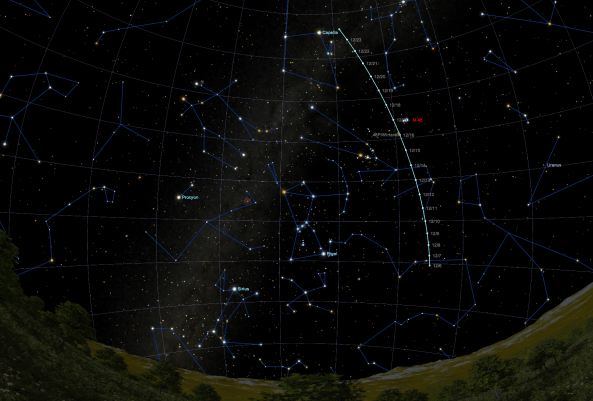
It appears that we might just have a bright comet for the end of 2018 and into the start of 2019: Comet 46P/Wirtanen. With a short period of just about 5.4 years, this time around the Sun, it will be very close to Earth (a mere 0.07AU or 11.6 million km) and enjoying its perihelion, too….. Predictions at this stage suggest a magnitude 3 object, well within the visibility range of the human eyeball.  When and where to look?  Here is an overall map of the comet’s path through December. Note that the perihelion date in December 16th, then the comet should be near its brightest:

Comet 46P/Wirtanen throughout December 2018. (click to enlarge)

Comet 46P/Wirtanen throughout December 2018. (click to enlarge)

On the night of 16 December for mid-latitude northern observers, looking south, this is what you should see…a lovely view of Orion and surrounding constellations. The comet should be near the Pleiades, making for a fine photographic opportunity.

Looking south of 16 December. (click to enlarge)

Looking south of 16 December. (click to enlarge)

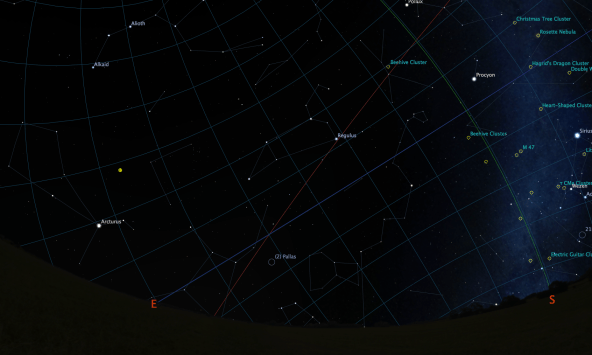
The Orionid Meteor Shower 2018

A good meteor shower to watch is the annual Orionids. This one originates from the famous comet:  1P/Halley – yep, that one!  As the comet orbits the Sun, little particles are left behind all over the place along the path.  When our planet orbits through this debris, we see a meteor shower. This year, the peak night will be October 21-22, 2018… some time around 2:00am will be when the shower radiant is high in the sky. All you need is a good dark sky to view from. No optical gear is needed. Suggestions for those nearing winter:  A sleeping bag, hot drinks, and some snacks. The image below shows that evening at about 1:30am local time with Orion rising in the southeast. The small red circle is the radiant from which the Orionid meteors will seem to emanate.

orionid radiant

The sky as it will appear in the early hours of the morning looking southeast. The Orionid radiant: red circle.

The Annual Perseid Meteor Shower

Each August, the Earth passes through a stream of comet debris from Comet 109P/Swift-Tuttle.  The comet will not be back our way until 2126… so… I wouldn’t wait up for that one.  Along the orbital path, the comet has left behind small bits and pieces, most no bigger than a grain of sand. These run into our planet’s atmosphere and burn up due to friction. The result of this friction-filled reentry is a meteor, a rapid streak of light through the sky.  This shower usually gives us about 60 meteors per hour at peak, and many fireballs: bright meteors that can even be bright enough to cast a shadow.  How to see it?

  • Pick a clear night closest to the peak, which is on August 12th/13th.
  • Go to a dark sky site: avoid lights and cities. The darker, the better.
  • Bring something comfortable to lie down on: sleeping bags are good.
  • Bring food, drink, and bug spray if needed for your location.
  • Spend the night time hours looking up at the sky! No optics required other than your eyeballs.
  • Avoid lights!  No cell phones. No flashlights. Your eyes take between 30-60 minutes to become dark adapted, and you lose that dark adaptation instantly if you see a light. Avoid lights!
  • The shower appears to come from a spot in the sky in the constellation Perseus. This rises just before midnight, so best observing will be after that, into the morning hours.
  • Have fun!


A Meeting of the Moon and Venus

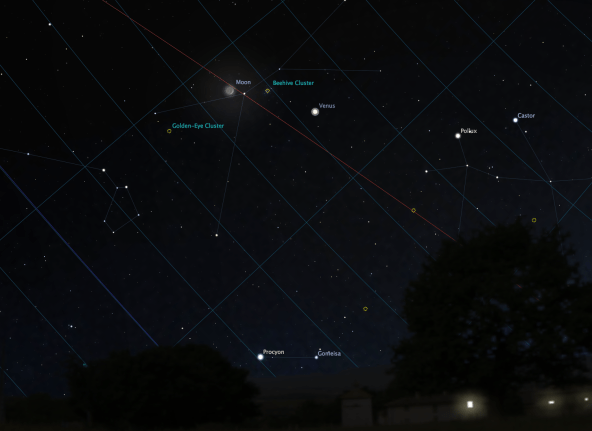
Mark your calendars for June 16th 2018: the Moon and Venus will slowly get to within 2.3 degrees of each other making for a lovely sight. All you have to do is head out in the early evening just after sunset and look to the lower western horizon.  You might also catch some bright later-Winter stars as well.  Here’s the view (click to make larger):

Venus and the Moon June 16th 2018

Venus and the Moon June 16th 2018 looking west after sunset.

While you are enjoying the view, take a close look at the Moon. You might just see something special, some Earth-Shine.  When the unilluminated portion of the Moon is visible, this is due to sunlight reflected off the Earth, bouncing back to light up the Moon, and making it appear a faint eerie blue color. Binoculars will make this really prominent. Enjoy!

Spring: the time for planets. They’re Back!

Now mid-March 2018 and there are planets in the sky!  Here are some of the notable moments.

If you look to the west right after sunset you will catch bright Venus and fleeting (and fainter) Mercury. On March 18th, just after sunset, you might also be able to catch the very young, sliver moon, low on the western horizon.

March 18th 2018 looking west right after sunset.

March 18th 2018 looking west right after sunset.

Are you and early riser? Then you will be able to catch the other bright planets, Mars, Jupiter and Saturn.

Jupiter, Mars, Saturn and the Moon visible at about 5:30am looking southeast on March 12th 2018.

Jupiter, Mars, Saturn and the Moon visible at about 5:30am looking southeast on March 12th 2018.


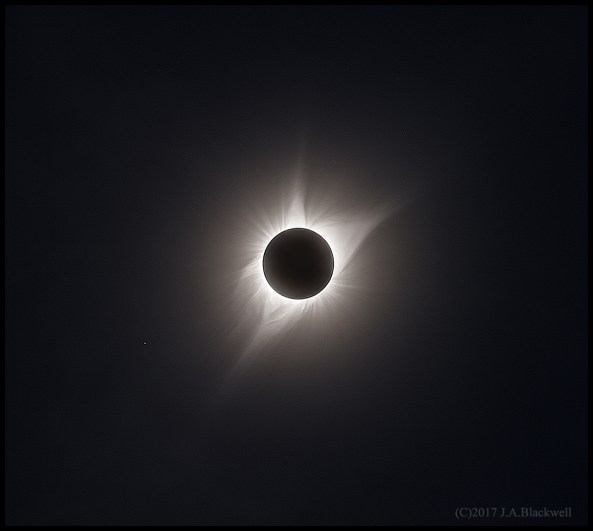
HDR of Eclipse Totality

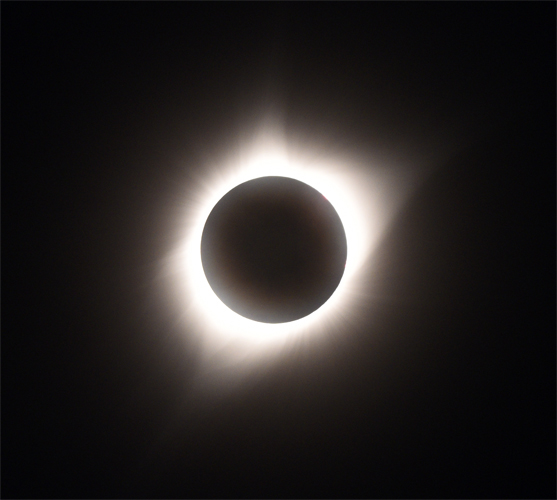
With some more time back at the regular computer, I have had the ability to merge some of the eclipse images together to make a solid HDR image of totality. This is what I call quite the Photoshop workout. This is a merge of 12 images ranging from innermost corona out to the outermost corona that did not wipe out the moon’s dark disk.  Some 20 hours went into this. The star to the lower left is Regulus in Leo.

HDR of the 21 August 2017 solar eclipse.

HDR of the 21 August 2017 solar eclipse.

Totality from Casper, Wyoming

The eclipse was a perfect success! Clear skies prevailed throughout totality, with forest fire smoke and clouds coming in after it was all done. The temperature dropped from 88 to 68F, stunning! The corona was larger than those I had seen before. We had prominences and more. MANY images to deal with and not fast internet, so please be patient while I get these things edited and out there. It might take a while… a week or more. In the meantime, here are a couple of unedited shots.

Casper was most generous: we had an excellent space from which to observe: green grassy fields on to the hill to the east of town. The parking lot lights and grass watering sprinkler systems had been disabled for the day. The medical center even provided a lunch at the end!

Mid Corona 2017

Totality: This is the mid-corona using a longer exposure to show the fainter regions.


Inner corona 2017

Totality: The inner corona. Note the fain, pink solar prominences on the right limb.


Partial stage 2017

Partial stage as the eclipse begins. There are a few sunspot groups to see there.


Diamond ring 2017

The diamond ring as the eclipse reaches totality.

A Casper Saturday: People Arrive!

The town of Casper, WY is now hopping along. A lot more people are here today. We started out with a visit to the Geology Museum on the southwest side of things. They have an excellent display on geologic time along with representative minerals and fossils from each period/era. They also have their very own T.rex skeleton, a nice surprise. It is being slowly picked out of the encasing rock….

So, there was a lot of good paleontology to enjoy there for sure!

Back into town, the place is swinging. Lots of people wandering about with geeky T-shirts… yes, these are eclipse watchers for sure. The town has closed off the central area for shops to show off their goods, for people to mill about, to have a quick bight to eat/drink, and relax in the summer sun, a hot summer sun, pushing to 90F. The skies today: crystal clear. Absolutely lovely.

Arrived: Casper Wyoming

All, I am safely here at Casper, Wyoming, right on the line for the eclipse. We DID have rooms in the local motel (YAY!) and have been rambling through town a little to get oriented. The town is divided in a couple of neat ways: the Platt River runs through as does a major train route frequented by the BNSF RR and others. The town has a basic grid layout with a couple of highways to help with faster circumnavigation. It is clear, sunny and hot, and the weather is supposed to stay that way through the eclipse. Restaurants and businesses are all out in full force with eclipse gear: shirts, hats, pins, logos, stickers, drinks. One can not make way through town without seeing some reference or another. Yesterday as we drove into town, there was little in the way of traffic, so I surmise that there will be a LOT of traffic today and tomorrow. In short: ALL is GO for eclipse 2017 here.