Exeter Astronomy Conference 2015

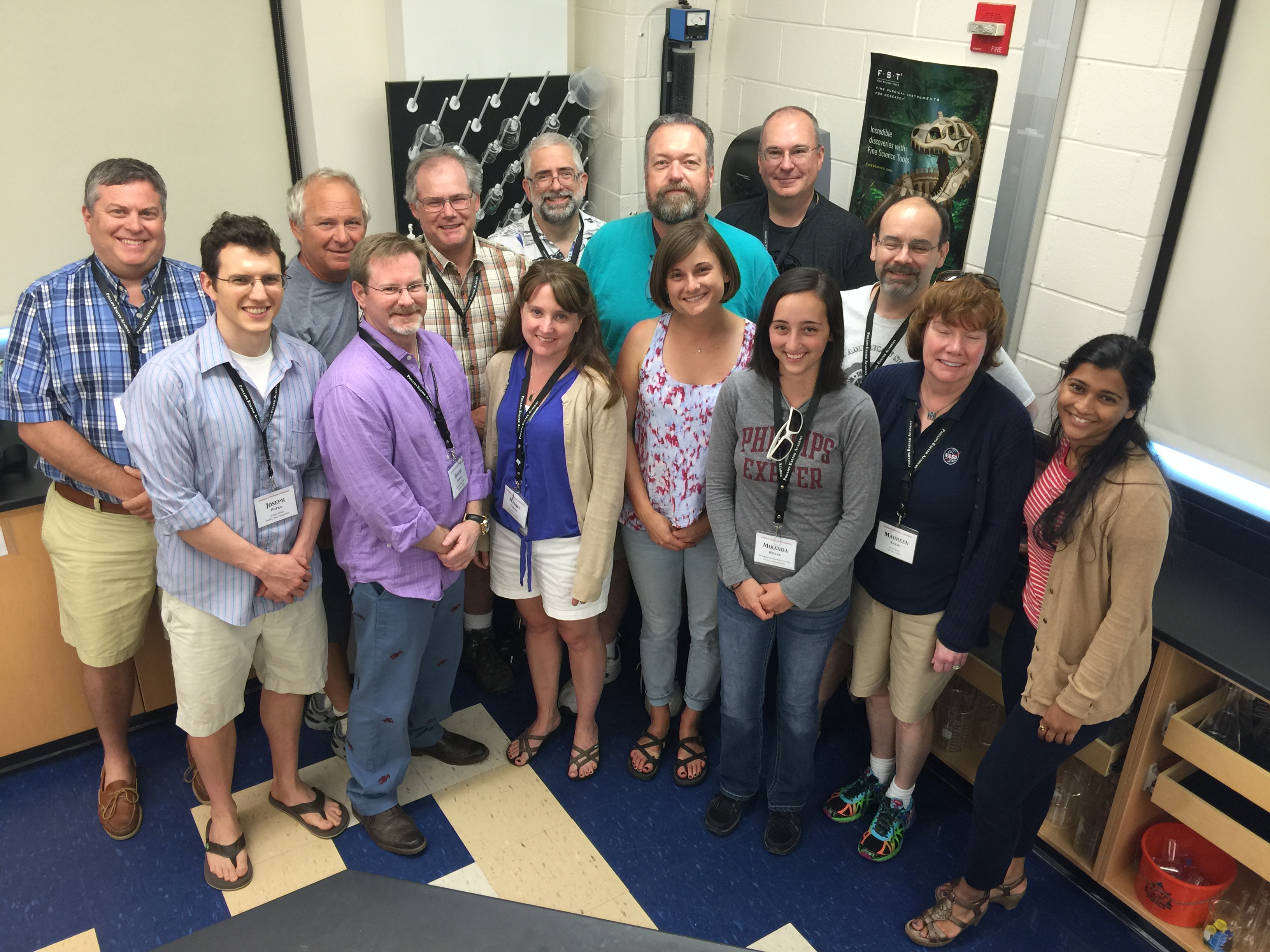
What a marvelous week this has been! We had 13 visiting educators here for detailed discussions and hands-on learning about astronomy, astronomy education, technology and methods…. all excellent!

Attendees 2015

Left to right, back row: Ben Moss, Peter Pitman, Brad Vietje, Joseph Acker, Tom Rutherford, John Blackwell, James Dickens. Front row: Joseph Putko, David Temple, Wendy Curtis, Faith Tucker, Miranda Heller, Maureen Adams, Anisha Vinod.

M57 RGB Color

Taken during our Astronomy Education Conference this last week… this is an RGB shot of the Ring Nebuka, M57 taken through the RCOS-10 at prime focus with an STL-6303 imager. 8:8:8 minutes per filter, color stacked and cropped in MaxIm DL.

M57_RGB_Sigma_Clip_Stack

Some Aurora from Exeter

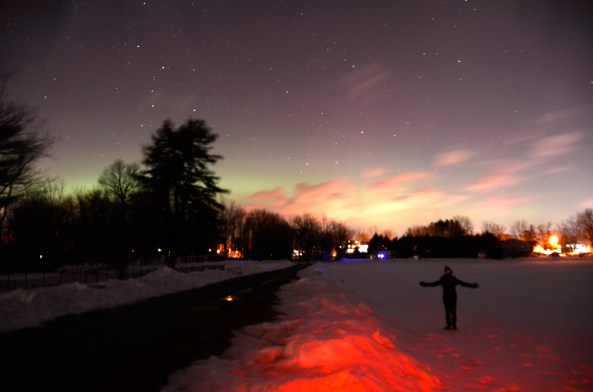
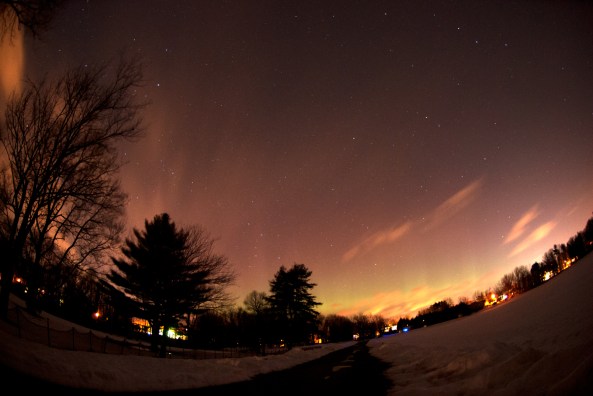
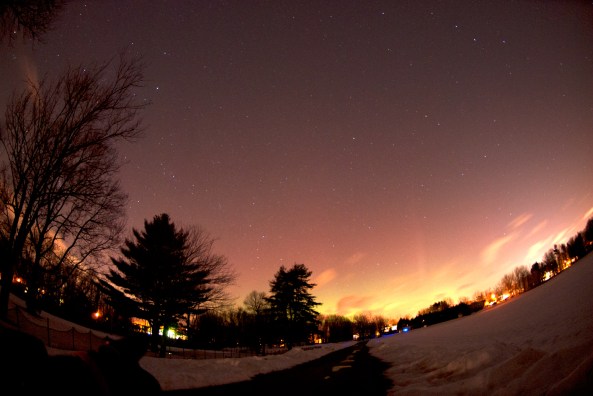
Early yesterday morning a coronal mass ejection smacked into the Earth and sent the magnetosphere into a spin. Aurorae were visible across all of the arctic regions and much further south. Last night was clear, and the geomagnetic storm continued well into the night, fading from our view at about midnight local time. We got some images from the fields near the football stadium, looking to the north over the observatory. These are 20 second exposures at 400ISO using Nikon D200 and D7000.

Aurora March 17, 2015

Aurora March 17, 2015

Aurora March 17, 2015

Aurora March 17, 2015

Aurora March 17, 2015

Aurora March 17, 2015

Aurora March 17, 2015

Aurora March 17, 2015

Geminids are here!

This weekend gives us the peak of the annual Geminid Meteor Shower, a fun event that can produce some 60 meteors per hour (one each minute) if you are observing from a dark sky site. This is a good shower and rarely disappoints, like the summer Perseids. The only difference? For the Geminids, we have to get really dressed for the cold! No telescopes required. Best times are this Saturday night and this Sunday night from 10pm local until dawn the next day. Let us hope for clear skies!….and a small additional tidbit: most meteor showers are caused by the Earth crossing the orbital path of a comet. In the case of the Geminids, this is not the case. Instead we pass through the orbital path of an asteroid named 3200 Phaethon.

A Clear Night and the Veil

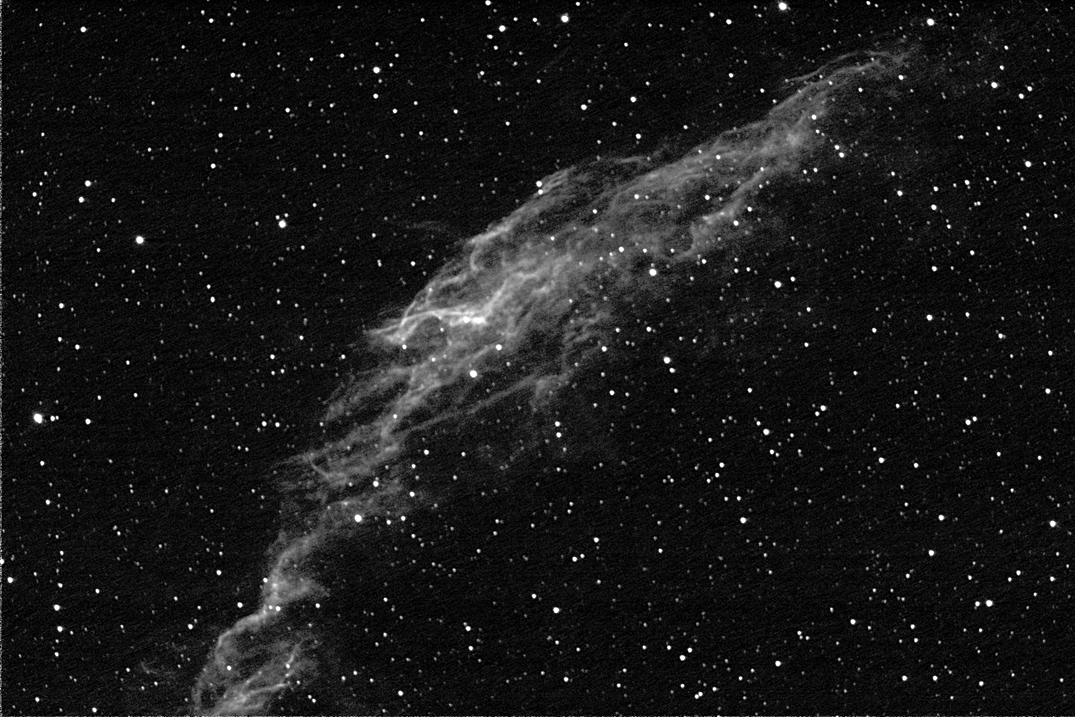
Nice cool late summer evening last night with temps falling into the 30s. The sky was crystal clear, so among all the activities of the open house and visiting students, I got the robotic telescope aimed and snapping shots of the Veil in Cygnus. This is a 32 minute stacked exposure through H-alpha at -10C. There was extensive processing done in MaxIm DL and Photoshop to bring out the detail, hide the noise and make it the nice pic it is. I think it could easily take another 4 hours of integration time to really bring out the full glory of this splendid nebula.

Veil

Click for full view.

Comet 2014 E2 Jacques

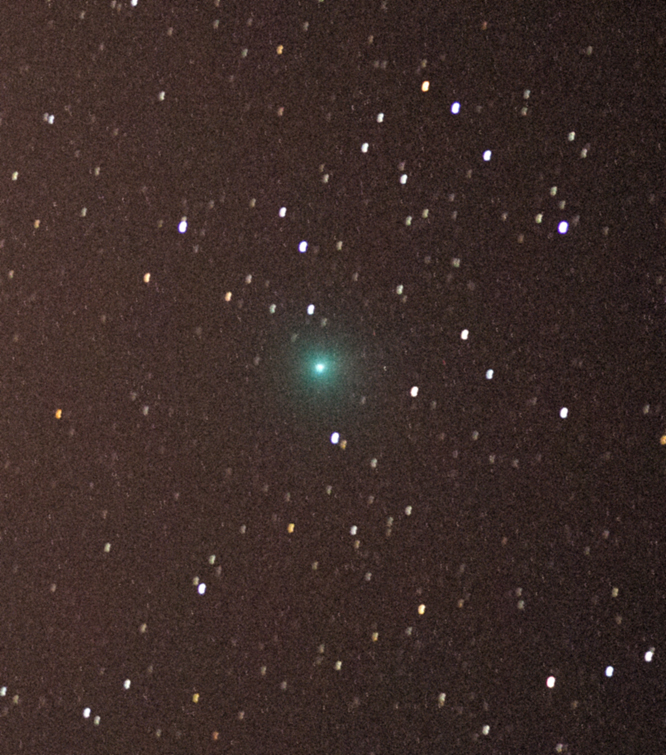
Comet Jacques made its way into being relatively bright this August. It was not something to see without optical aid however. A telescope or good binoculars were required. I took the Nikon D7000 out with a 200mm lens, attached it to the back of our observatory’s Takahashi refractor and then took a series of images. Some work in Photoshop stacking 5 minutes of images rendered this…..

Jacques-082514-5min

Comet 2014 E2 Jacques: a 5 minute total stack of 30 second images taken through 200mm using Nikon D7000, 25-August-2014.


When planets conjunct! Part 2: a 4:30am session

I have been getting up at 4:30am each morning for the last three days to see if we have a good clear sky. Today was that day, and low in the northeast were Jupiter and Venus making a show of their conjunction.  I got some pics for you. The first is a view of rising Orion and the waning crescent moon with the morning ground fog. Be sure to click on the images to get into a larger view.

Orion-moon-082814 venus-jupiter-082014 venus-jupiter-082014b

When Planets…. Conjunct!

Tomorrow offers a fine opportunity to see a brilliant planetary alignment, or conjunction, of Jupiter and Venus. If you go out before sunrise and look east, low to the horizon, you will see Venus and Jupiter very close to each other. It is not a very common event, so it is worth going out to see.

Here is what you might see with the unaided eye tomorrow morning (Aug 18th) at about 5:00am EDT from Exeter, NH:

jupitervenus1


And, through a pair of binoculars, you can see the planets well separated with Venus to the lower left and Jupiter to the upper right:

jupitervenus2


A Night in Sagittarius

Every now and then we get a perfect evening, I mean a perfect night. The stars are steady, there is no wind, the crickets are chirping, and the sky is dark and clear. Last night was such a night, so it called out to me: GO OUT and IMAGE! That’s what I did.  After turning on the equipment and cooling the CCD to -10C (not all that cold given the 90F temps outside), the telescope had to be convinced to point in the proper direction. It somehow managed to get itself into a situation where due south was aiming straight down. Not good. After wrangling with that, biases, darks and flat field frames had to be taken. Sunrise had just taken place, so now it was time to wait for darkness.  I worked with my kiddo, Jren, to teach the basics of DSLR nighttime photography: bunnies, bats, then stars were the targets.  Now, with darkness in place, what to image?  Well, there are few constellations in the summer with as many cool objects as Sagittarius. At the heart of the Milky Way, there are plenty of open clusters, reflection and emission nebulae, and globular clusters to hunt through. I chose one of my favorites, the Omega Nebula. I call it the Swan Nebula, as, to me, it looks like an inverted swan in the telescope. It goes by many other names: The Omega Nebula, Checkmark, Lobster and Horseshoe Nebula… and M-17, or even NGC 6618. Take your pick. They all work.  The image below is the result.

This is a one-hour integration of M-17 through a narrow band Hydrogen Alpha filter using the robotic observatory’s 10″ RC telescope and STL-6303 CCD imager operating at -10C. Not bad!

M-17 Ha