
This weekend gives us the peak of the annual Geminid Meteor Shower, a fun event that can produce some 60 meteors per hour (one each minute) if you are observing from a dark sky site. This is a good shower and rarely disappoints, like the summer Perseids. The only difference? For the Geminids, we have to get really dressed for the cold! No telescopes required. Best times are this Saturday night and this Sunday night from 10pm local until dawn the next day. Let us hope for clear skies!….and a small additional tidbit: most meteor showers are caused by the Earth crossing the orbital path of a comet. In the case of the Geminids, this is not the case. Instead we pass through the orbital path of an asteroid named 3200 Phaethon.
Category Education
A Clear Night and the Veil
Nice cool late summer evening last night with temps falling into the 30s. The sky was crystal clear, so among all the activities of the open house and visiting students, I got the robotic telescope aimed and snapping shots of the Veil in Cygnus. This is a 32 minute stacked exposure through H-alpha at -10C. There was extensive processing done in MaxIm DL and Photoshop to bring out the detail, hide the noise and make it the nice pic it is. I think it could easily take another 4 hours of integration time to really bring out the full glory of this splendid nebula.
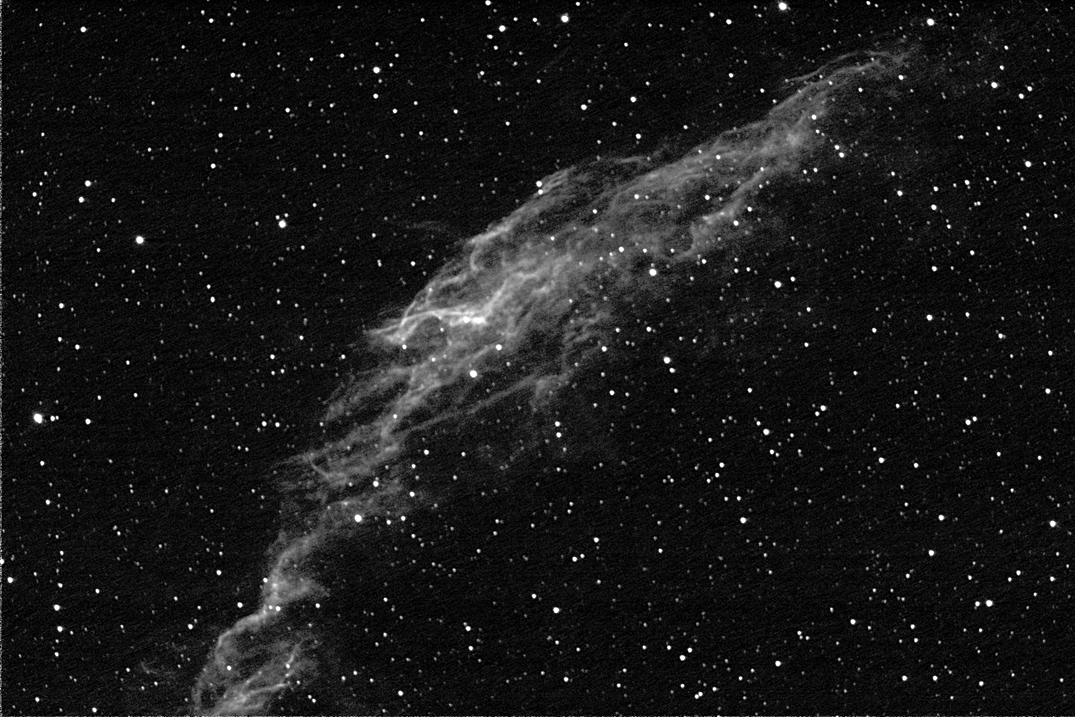
Click for full view.
Comet 2014 E2 Jacques
Comet Jacques made its way into being relatively bright this August. It was not something to see without optical aid however. A telescope or good binoculars were required. I took the Nikon D7000 out with a 200mm lens, attached it to the back of our observatory’s Takahashi refractor and then took a series of images. Some work in Photoshop stacking 5 minutes of images rendered this…..
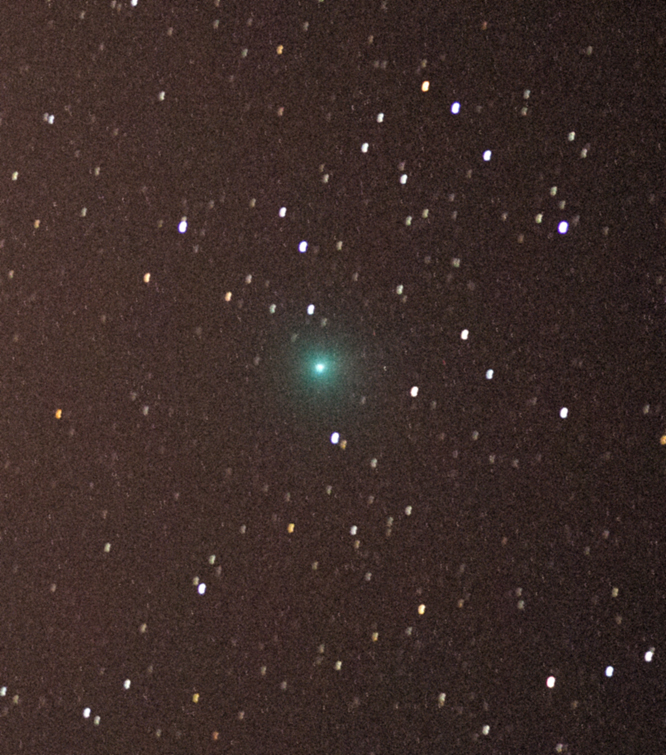
Comet 2014 E2 Jacques: a 5 minute total stack of 30 second images taken through 200mm using Nikon D7000, 25-August-2014.
When planets conjunct! Part 2: a 4:30am session
I have been getting up at 4:30am each morning for the last three days to see if we have a good clear sky. Today was that day, and low in the northeast were Jupiter and Venus making a show of their conjunction. I got some pics for you. The first is a view of rising Orion and the waning crescent moon with the morning ground fog. Be sure to click on the images to get into a larger view.


When Planets…. Conjunct!
Tomorrow offers a fine opportunity to see a brilliant planetary alignment, or conjunction, of Jupiter and Venus. If you go out before sunrise and look east, low to the horizon, you will see Venus and Jupiter very close to each other. It is not a very common event, so it is worth going out to see.
Here is what you might see with the unaided eye tomorrow morning (Aug 18th) at about 5:00am EDT from Exeter, NH:
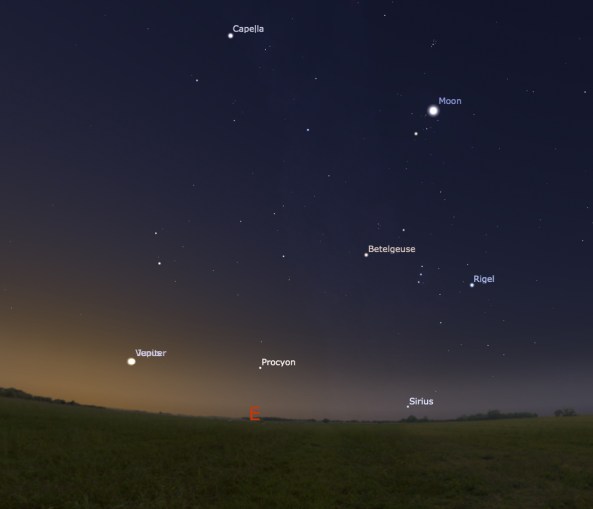
And, through a pair of binoculars, you can see the planets well separated with Venus to the lower left and Jupiter to the upper right:

A Night in Sagittarius
Every now and then we get a perfect evening, I mean a perfect night. The stars are steady, there is no wind, the crickets are chirping, and the sky is dark and clear. Last night was such a night, so it called out to me: GO OUT and IMAGE! That’s what I did. After turning on the equipment and cooling the CCD to -10C (not all that cold given the 90F temps outside), the telescope had to be convinced to point in the proper direction. It somehow managed to get itself into a situation where due south was aiming straight down. Not good. After wrangling with that, biases, darks and flat field frames had to be taken. Sunrise had just taken place, so now it was time to wait for darkness. I worked with my kiddo, Jren, to teach the basics of DSLR nighttime photography: bunnies, bats, then stars were the targets. Now, with darkness in place, what to image? Well, there are few constellations in the summer with as many cool objects as Sagittarius. At the heart of the Milky Way, there are plenty of open clusters, reflection and emission nebulae, and globular clusters to hunt through. I chose one of my favorites, the Omega Nebula. I call it the Swan Nebula, as, to me, it looks like an inverted swan in the telescope. It goes by many other names: The Omega Nebula, Checkmark, Lobster and Horseshoe Nebula… and M-17, or even NGC 6618. Take your pick. They all work. The image below is the result.
This is a one-hour integration of M-17 through a narrow band Hydrogen Alpha filter using the robotic observatory’s 10″ RC telescope and STL-6303 CCD imager operating at -10C. Not bad!

Lunar Eclipse Time!
This month we have an awesome opportunity to see one of mother nature’s best sights, a total lunar eclipse. In fact much of the western hemisphere will be in the proper location. The night of April 14/15 is the special time. For many, totality will be in the early morning hours of the 15th. Have some coffee ready! What to expect? Well, total lunar eclipses are quite lovely and can vary in appearance significantly. Usually, as the moon gets deeper into the umbral shadow of the earth, the moon turns a dark orange red color, corresponding to the color of a total all-earth sunset. Sometimes totality is marked by a deep charcoal shade with an orange cast to it. The eclipse process is slow. much slower than watching the totality of a total solar eclipse. Here are some times:
| Event | AKDT(-8h) | PDT(-7h) | MDT(-6h) | CDT(-5h) | EDT(-4h) | |
|---|---|---|---|---|---|---|
| Evening April 14 | Morning April 15 | |||||
| U1 | Partial began | 8:58 pm | 9:58 pm | 10:58 pm | 11:58 pm | 12:58 am |
| U2 | Total began | 10:07 pm | 11:07 pm | 12:07 am | 1:07 am | 2:07 am |
| Mid-eclipse | 10:47 pm | 11:47 pm | 12:47 am | 1:47 am | 2:47 am | |
| U3 | Total ended | 11:25 pm | 12:25 am | 1:25 am | 2:25 am | 3:25 am |
| U4 | Partial ended | 1:33 am | 2:33 am | 3:33 am | 4:33 am | 5:33 am |
Ok – so what do all these times mean? You will not really notice the partial phases of the eclipse. If you are taking photos of the full moon during partial phase, you will see a slight dimming of one side of the moon as it travels into the earth’s penumbra. You will notice the darker shadow of the umbra as totality phases begin, at U1. This chunck of darkness will eventually darken the entire moon (U2) which begins the totality phase of the eclipse.
Here is a photo of a partial lunar eclipse. Notice how subtle the shading is on the lower right of the moon. (10/18/2013 J. A. Blackwell)

A total eclipse will be much more pronounced. Here is a series of images from a total eclipse that we took a number of years ago here at the Academy. A hint as to the date: the Red Sox won the series that night! (2/28/2008 J. A. Blackwell and Students)

Ok – so – all you need? A comfortable location, warm clothing, some warm food/drink, friends and perhaps some binoculars. I like to use a sleeping bag on a lounge chair. If you want to take photos of the event, a stable tripod mounted DSLR camera and medium focal length lens (200mm or so) will do nicely. We use a 6″ Takahashi refractor on a permanent mount, but that is overkill…. fun…. but overkill. DSLRs allow one to bracket exposures and take many photos rapidly. If you take one image each 5 minutes, you can get a lovely sequence of photos that you can string together.
For the various other attributes of the eclipse, check this out (from Fred Espinak’s NASA Eclipse Page): go here.
Enjoy! Have fun! Share the sky!
Cosmology Takes a Leap Forward?
The topic, science: the stuff of all my dreams. It demands patience, creativity, a willingness to work hard, to get things wrong, to be serious and silly, and to validate through evidence. This week has been a real news-making one…. lots going on in the world of astronomy and cosmology. Let’s see if this can be untangled in some ways.
Astronomers collect data about the universe. We use telescopes, among other tools, to collect photons, those little packets of energy that travel at c, light-speed in a vacuum, and then convert all that to numbers. Telescopes collect all sorts of photons: visible ones (we call light), IR, UV, radio, x-ray, gamma-ray, and microwaves. Sometimes cosmologists have been seeking the results of all that data collection that astronomers have been doing. Cosmologists are those that work to better understand the start, evolution and end of the Universe… yep, the whole thing. It’s a daunting task.
Big Bang Theory? Yep – that is cosmology. Astronomers provided the needed observations to show that it was likely to be the start to the Universe. Edwin Hubble observed data which shows that gravitationally unbound galaxies are rushing away from each other at a pretty constant rate of expansion… now called Hubble’s Constant. Well, maybe it’s not as constant as we had thought back in the 1920s. Astronomers (well, actually some people working to better telecommunications on Earth) came up with observations of the cosmic microwave background – pretty solid evidence for the afterglow of the Universe’s boom.
This week, a new observation. This time, scientists used a facility called BICEP2 ( go here for their site: http://www.cfa.harvard.edu/CMB/bicep2/ ) located at the South Pole. Nice working conditions there, I bet! This instrumentation uses a set of devices called bolometers. Bolometers collect photons and measure the power (in Watts) received. A Watt is how much energy the system is receiving (in Joules) each second. These bolometers are a little special. They measure photons at microwave wavelengths. They also have the ability to look at how those microwave photons are oriented as they travel to the detector. This orientation is called polarization. If a photon vibrates in multiple directions as it travels, we say that it it unpolarized. If it vibrates in one direction, then it is called polarized. More on this here if needed: http://www.physicsclassroom.com/class/light/u12l1e.cfm
Going back some years, cosmologists were deeply concerned about several issues that the Big Bang theory presents: More on these issues? A great writeup is located here at Wikipedia. The key here is that Allan Guth (now an MIT professor) developed a solution to these which then became called the Inflationary Theory. This is not the only cosmological theory which solves the issues, but it is a strong one. This week, it becomes a little stronger. Reasoning? The Inflation theory predicts that we should see polarized photons in certain alignments that show the existence of gravity wave influences during the early moments of the Inflationary Period of the Big Bang. That is exactly what the BICEP2 experiment has done, found this pattern of polarization in the microwave background. It is pretty astounding and goes a ways to confirm that Inflation is the theory most likely to be correct, but wait! All good science needs confirmation with new and separate evidence. Here we go! Stay tuned to the ever-unfolding developments in cosmology and observational astronomy.
More? Try these:
Aurora in Iceland
Just back from a trip to Iceland to study geomagnetism and the aurora opportunities there… as well as the incredible geology. Here are some aurora images from the trip all taken with a Nikon D7000 and a variety of lenses. Last is a daytime panoramic view of one of the glacial regions. Enjoy!


Supernova PSN J09554214+6940260 in M-82
Some 11.5 million light-years away, the light from this explosion has just reached our telescopes! It’s in the magnitude 11.4 range and promising to get brighter in the next week. Observers in the northern hemisphere will find this object well placed just above the bowl of the Big Dipper asterism in the Messier-82 galaxy, the Cigar Galaxy. The star is an obvious newcomer, residing right in the midst of the galactic edge. Here is our first image from last night (January 22, 2014), 3 minutes through an R photometric filter, 10″ RC, STL-6303 imager at -30C.

 ExeterAstro