Some Geminids

New England offers some of the most challenging conditions for astronomers. As local say, if you don’t like the weather just wait five minutes! This year we were blessed with some relatively clear skies for the annual Geminid meteor shower. The shower is due to small particles of material that have fallen off of the rocky comet called 3200 Phaethon, an object which makes its orbital path very close to the Sun (hence the name Phaethon) and then out to some 2.4 AU away from the Sun at aphelion.

Geminids 2012

A Geminid meteor streaks across the sky over Exeter, New Hampshire. Nikon D7000, 30s, f/2.8 at 10.5mm

A Visit to a remote Observatory

Recently I had the opportunity to visit a remote observatory in northern Vermont. The wonder of a remote site is definitely in the darkness of the skies. This enables a telescope to image fainter objects in less exposure times. At this site, the Milky Way was visible from horizon to horizon, with nearly zero light pollution. The only lights we saw were in the town, and they were few and far between. Here is an image of the Dumbbell Nebula (M-27) taken with their scope, a 17″ RC. The image was an LRGB color composite using 5 minutes in each LRG and B.

M-27 Dumbbell Nebula

An LRGB Color composite at 5min each filter.


A Shakin’ Night at the Domes

We had an interesting evening last night down at the observatory. Three classes came down to do a little binocular astronomy. In the middle of the first class, just shortly after 7:00pm local time, everything started to shake! It turns out that we just had an earthquake, something we are not all that acustomed to here in New England. They happen from time to time, but most people don’t even feel them. This was a good long shake, measuring in at magnitude 4.0…. the funny thing: most of the students were flat on their backs looking up at the starry sky with binoculars, so it was a perfect opportunity to feel the quake. More information here at the USGS site.

For the next couple of hours, we notes aftershocks, but not in a way that you’d expect. We couldn’t feel them, but we saw them!  We were using the echelle spectrograph which uses a high sensitivity video camera to track on the stellar targets. When an aftershock hit, we could see the star’s image vibrating back and forth rapidly on our screen.


New England Fall Astronomy Festival

All, I am planning to speak at this one: check it out! If you happen to be in New England at that time, we would love to have you join us.  ~john

Explore starry wonders both day and night

September 21 – 22, 2012

UNH Observatory | Durham, NH

physics.unh.edu/observatory/NEFAF

Celebrate the September sky with the New England Fall Astronomy Festival, an annual event held at the University of New Hampshire Observatory. Presented by the UNH Physics Department and the New Hampshire Astronomical Society, the festival brings together astronomers of all ages for a fun-filled weekend of discovery. Learn from astronomy experts, attend a telescope clinic, safely observe the sun, and explore the night sky through dozens of telescopes. Children can participate in hands-on activities, games, and demonstrations. NEFAF promises an immersive, space-related experience for anyone fascinated by the wonders of the universe.

Free admission, but donations much appreciated.

Beginning at 6 p.m. Friday, beginning at 10 a.m. Saturday.

Transit Observing Plan

THIS IS A WEATHER DEPENDANT EVENT:  Cancellations will be posted by twitter feed at http://www.twitter.com/PEA_Obs  

The transit of Venus on 5th June will be the last opportunity to see such an event until 2117.  It is therefore a last-chance-of-a-lifetime event for us.  It occurs as the sun is setting. Event timings are as follows for our location:

  • First Contact:                        6:04PM EDT         Venus’ edge appears on sun’s face.
  • Second Contact:                   6:22PM EDT         Venus’ complete disk is visible on the face of the sun.
  • Sun Sets Behind Trees:       7:40PM EDT         Transit viewing effectively ends for us.

A simulation of the event is available online at this address: http://www.sunaeon.com/venustransit/

Information for other locations is available at: http://eclipse.gsfc.nasa.gov/transit/venus0412.html

Our observing location will not be at the observatory, as that location has blocked westerly views. We will be setting up a portable observing site at the fields across from the observatory on the extreme eastern side.

SAFETY!

It is NEVER safe to observe the sun without proper filters. Observing the sun without safe filtration will damage the human eye immediately and irreversibly. We will have telescopes with proper filters available for you to observe safely. We will also have a telescope for imaging the event in coordination with other sites to use for scientific research.

More Information:

Please go to http://exeterastro.com for more information about this event and the Academy’s astronomy program as a whole. You can also go to http://twitter.com/PEA_Obs for last minute announcements.

Venus Nearing Transit

I had a few spare moments around the observatory last night. The Sun was still lurking just above the western horizon, the dome was open, cooling off, and a thought entered my mind: hey, I bet Venus is visible through those trees!  Exeter is a small town, and the observatory is crammed into a small section of Academy fields on one side, the river and town on the other two sides. Trees block the western view, but in this case a little luck dropped by.

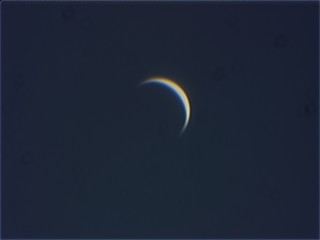
Slewing the telescope over to the west, there was Venus, easily visible in broad daylight. I took a quick peak through the eyepiece: wow, a perfect crescent, and that made perfect sense. Venus is headed into transit on June 5th: it will become an increasingly thin crescent until that magic moment of transit.  Not wasting a minute (I was really bustling in the dome to get this to work out), I found a webcam and some extra long USB cables and took the following. Enjoy! This is through a Celestron SCT using a ToUCamII Pro. Registax was then used to stack 1000 images for the final shot.

venus 18 May 2012

And for those interested in the raw footage, here it is: If you listen carefully you can here the drone of the Paramount telescope drive system and some mumblings by yours truly as the seeing conditions got worse. 😉

A Word of Observing Caution

UPDATE:  The NHAS has posted their preliminary observing locations and maps:  http://nhastro.com/events/transit.php

This June 5th, we have an opportunity to see a rather rare astronomical event, the transit of Venus, when the planet Venus gets between our Earth and the Sun. The result is that we can see the small, round dot of Venus’ silhouette traversing across the bright disk of the Sun. This event has both tremendous scientific and historic significance in astronomy, but it also has its dangers.

The Sun is bright, something we all know. We shouldn’t look at it without proper protection, namely solar filters. One should definitely NOT look at the Sun through a telescope unless one employs a full aperture solar filter which has been approved for visual solar observing. Failure to adhere to this warning means instantaneous and irreversible damage to your eyes.

  • Do not employ dark glass for a solar filter.
  • Fogged film is not an appropriate solar filter.
  • Dark sunglasses are not appropriate solar filters.
  • Welding glass used at the eyepiece of a telescope is NOT a safe solar filter.

If you are interested in seeing the transit using safe equipment, and you are not sure what to purchase, you have some options:

  • Visit your local astronomical society or planetarium and ask the astronomers there for equipment suggestions.
  • An affordable solution to see the transit without optical aide would be to purchase some “Eclipse Glasses” from a source like Amazon. This one comes in a package of 5:  HERE.  WARNING!!!  DO NOT USE THESE IN COMBINATION WITH BINOCULARS OR OTHER UNFILTERED OPTICAL SYSTEM. These cannot withstand the light and heat concentration put out by optical instruments. These are for wearing alone.
  • Many local astronomy clubs, societies and associations will be setting up equipment for the public to use in order to view the event. The New Hampshire Astronomical Society is doing just that and will post information at http://www.nhastro.com as they prep for multiple observing sites throughout the state on the afternoon of June 5th.
  • From the east coast (New Hampshire), the Sun will be setting as the transit begins. Some observatories, including the one at Phillips Exeter Academy will not be able to see the Sun through trees and houses which will obstruct the view. In these cases the observatory will remain closed, and a portable observing location would be set up elsewhere at a higher elevation with a clear westerly view. Stay tuned to your local club’s/observatory’s websites for more details.

Historical Significance:

Transits were one of the earliest observational methods used to determine an accurate measure of the Astronomical Unit, the average distance between the Earth and the Sun. Using two widely separated observing stations and precise timepieces, observers would note the time difference between the start and end of the transit. Using then the mathematics of triangles (parallax) and Kepler’s Laws of Planetary Motion, the distance could be calculated.

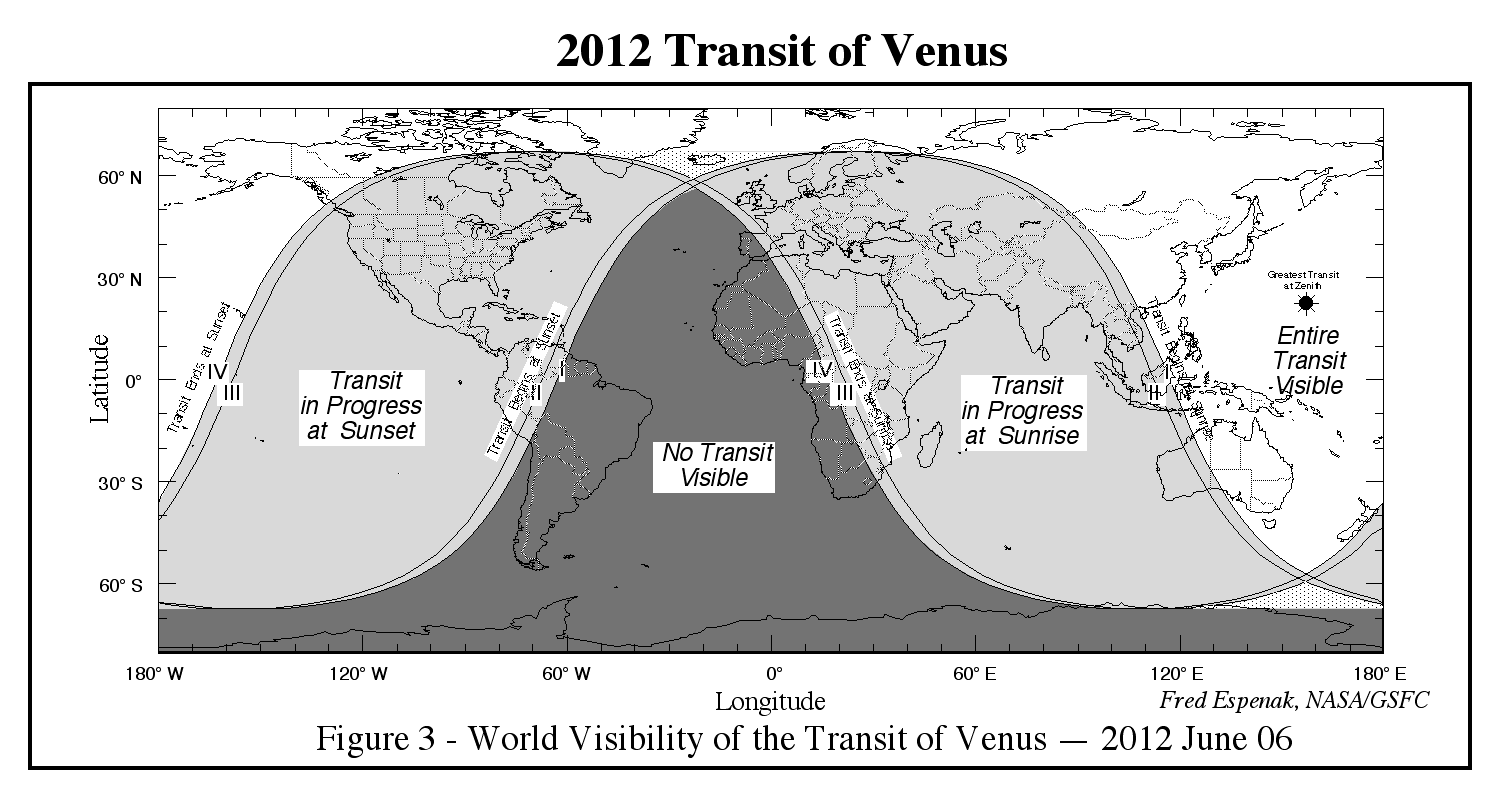
The earliest observation of this type actually involved the planet Mercury transit of the Sun in 1676. A rather famous astronomer (you know the name!), Edmund Halley, made observations from St. Helena. One other set of observations was made elsewhere, but the mathematics proved to show some serious inaccuracies. In 1761 (and by this time Halley had passed away), there was a Venus transit. Many sites were established to observe the event. In 1769, another Venus transit was observed, and also created a large scientific collaboration between countries. This was also the first event which marked Captain James Cook’s initial voyage through the Pacific. Future transits were then observed, the last in 2004. The next one will be in 2117 (December 10-11), so this event in June 2012 will be the last we are able to see in our lifetimes.  To help you plan your transit, see the two images below. The first is from the Wikipedia article Transit of Venus, 2012. The second comes from the NASA Eclipse Website.

From: http://upload.wikimedia.org/wikipedia/commons/6/6b/VenusTransit2012-Map-2.gif

From: http://eclipse.gsfc.nasa.gov/transit/venus/Sun2004+2012-2.GIF

Drizzling: An Image Processer’s Dream Come True

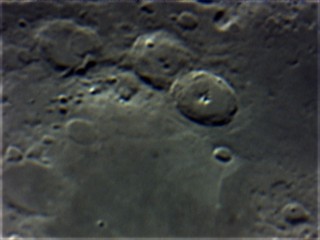
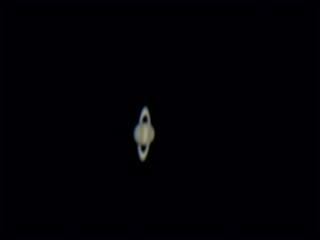
There are plenty of nearby astronomical objects to investigate with a small telescope, but one of the most insidious problems which gets in our way is the issue of “seeing conditions”. When objects on the ground are heated by sunlight during the day, they then radiate throughout the night causing what astronomers call poor seeing conditions.  One can look at the moon or Saturn and see a wavy image one second, only to be followed immediately by a mighty fine and perfectly sharp image of the object. What to do?  Enter modern technology!  A method that was originally developed for the Hubble Space Telescope and then further adapted for amateur use, the drizzling method has caught on by storm. One can even download freeware to try it out:  Registax, which actually does a lot more than simple drizzling.  In the Observational Astronomy class, we actually try this out using the humble webcam as an imager. Taking thousands of video frames, the Registax software takes the best of the images then aligns and averages them together to make one much much better image. This last week we did just that, and here are just a couple of results. All images were taken with a C11 SCT and a ToUCam-II Philips webcam.

Moon

Now, you might be thinking, yes, ok, those are fine images, but WAIT, there’s more!  These were taken in the early evening in the spring here in Exeter, NH. The diurnal variation can be as much as 40 or 50 degrees F!  There is a lot of post-sunset heat coming up off those rivers, buildings and parking lots!  This is the video of Saturn from which we captured the frames to make that one sharp image. This is what you would have seen if you were looking through the telescope in real time.


Saturn at Opposition

Astronomers use some interesting terminology: phrases such as “in opposition” and “at greatest elongation”. What do these phrases mean, after all? One is of particular note right now: “Saturn is at opposition.”

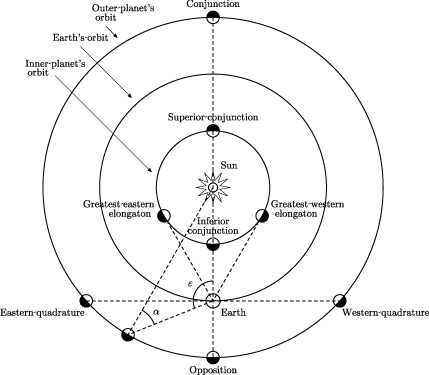
On April 15th, the planet Saturn will be located directly opposite the sun in the sky. They will be 180 degrees apart. This means that one could draw a line from the Sun, to the Earth, then right out straight to Saturn. This is a good thing for those interested in seeing the ringed world (or any planet in opposition). Planets at opposition are at their closest point to Earth and are at their brightest and largest apparent size.

The opposite is true for planets at “conjunction with the Sun.” Things in conjunction are placed in the same location in the sky from our vantage point. If Jupiter was at conjunction with the Sun, then it would be behind it and invisible to Earth-based astronomers.  The planet Jupiter in conjunction would also be specifically in superior conjunction, which means it’s on the far side of the Sun, since it can never be between the Sun and Earth. Planets like Mercury and Venus can be in superior conjunction or in inferior conjunction, when it is between the Sun and the Earth.

(image Wikipedia Commons)

For those inferior planets like Mercury and Venus, they have no way to reach an opposition position to Earth. They do however reach a position furthest from the Sun in the sky, and astronomers call that the point of greatest elongation. Planets at greatest western elongation appear to rise in the east just before the sun.  Planets at greatest eastern elongation set in the west just after the sun sets.

Other things can be in conjunction as well. A classic example would be the lovely conjunction of the planet Venus and the star cluster, the Pleiades, which occurred last week.  Those interested should definitely see this image of that event: APOD Venus Pleiades Conjunction.

A Comet: 2009 P1 Garradd

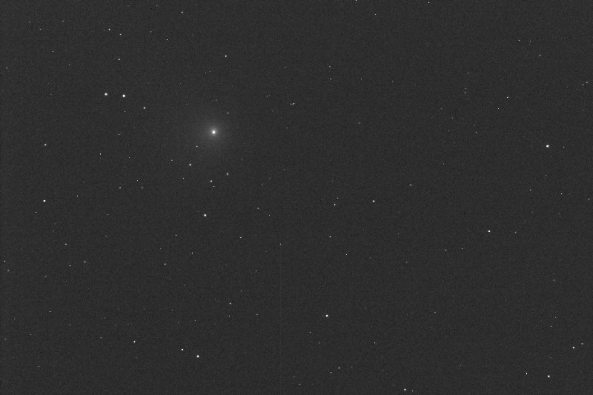
Such a clear night tonight, and it was the first day of classes for the spring term. The Observational Astronomy (Astro-3) class came out to peruse the various telescope types, look at the insides of a Schmidt-Cassegrain catadioptric, and then check out a bright comet through the scopes. Visually, Comet Garradd was not all that striking, appearing as one of the ubiquitous fuzz-balls that we all know and love in eyepiece astronomy. We got the robotic dome going, and that makes a big difference. Here is a one minute integration through a V filter of the comet using the robotic telescope.

2009 P1 Garradd