Drizzling: An Image Processer’s Dream Come True

There are plenty of nearby astronomical objects to investigate with a small telescope, but one of the most insidious problems which gets in our way is the issue of “seeing conditions”. When objects on the ground are heated by sunlight during the day, they then radiate throughout the night causing what astronomers call poor seeing conditions.  One can look at the moon or Saturn and see a wavy image one second, only to be followed immediately by a mighty fine and perfectly sharp image of the object. What to do?  Enter modern technology!  A method that was originally developed for the Hubble Space Telescope and then further adapted for amateur use, the drizzling method has caught on by storm. One can even download freeware to try it out:  Registax, which actually does a lot more than simple drizzling.  In the Observational Astronomy class, we actually try this out using the humble webcam as an imager. Taking thousands of video frames, the Registax software takes the best of the images then aligns and averages them together to make one much much better image. This last week we did just that, and here are just a couple of results. All images were taken with a C11 SCT and a ToUCam-II Philips webcam.
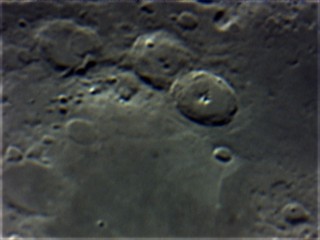
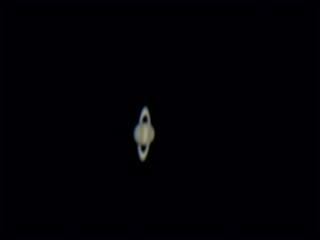
Moon

Now, you might be thinking, yes, ok, those are fine images, but WAIT, there’s more!  These were taken in the early evening in the spring here in Exeter, NH. The diurnal variation can be as much as 40 or 50 degrees F!  There is a lot of post-sunset heat coming up off those rivers, buildings and parking lots!  This is the video of Saturn from which we captured the frames to make that one sharp image. This is what you would have seen if you were looking through the telescope in real time.


Saturn at Opposition

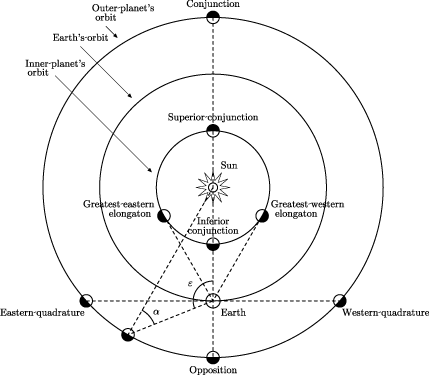
Astronomers use some interesting terminology: phrases such as “in opposition” and “at greatest elongation”. What do these phrases mean, after all? One is of particular note right now: “Saturn is at opposition.”

On April 15th, the planet Saturn will be located directly opposite the sun in the sky. They will be 180 degrees apart. This means that one could draw a line from the Sun, to the Earth, then right out straight to Saturn. This is a good thing for those interested in seeing the ringed world (or any planet in opposition). Planets at opposition are at their closest point to Earth and are at their brightest and largest apparent size.

The opposite is true for planets at “conjunction with the Sun.” Things in conjunction are placed in the same location in the sky from our vantage point. If Jupiter was at conjunction with the Sun, then it would be behind it and invisible to Earth-based astronomers.  The planet Jupiter in conjunction would also be specifically in superior conjunction, which means it’s on the far side of the Sun, since it can never be between the Sun and Earth. Planets like Mercury and Venus can be in superior conjunction or in inferior conjunction, when it is between the Sun and the Earth.

(image Wikipedia Commons)

For those inferior planets like Mercury and Venus, they have no way to reach an opposition position to Earth. They do however reach a position furthest from the Sun in the sky, and astronomers call that the point of greatest elongation. Planets at greatest western elongation appear to rise in the east just before the sun.  Planets at greatest eastern elongation set in the west just after the sun sets.

Other things can be in conjunction as well. A classic example would be the lovely conjunction of the planet Venus and the star cluster, the Pleiades, which occurred last week.  Those interested should definitely see this image of that event: APOD Venus Pleiades Conjunction.

A Comet: 2009 P1 Garradd

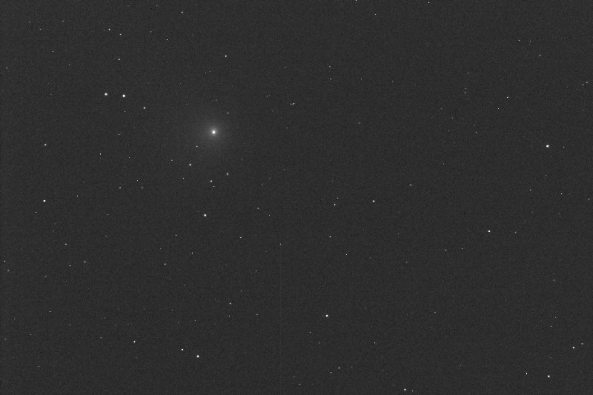
Such a clear night tonight, and it was the first day of classes for the spring term. The Observational Astronomy (Astro-3) class came out to peruse the various telescope types, look at the insides of a Schmidt-Cassegrain catadioptric, and then check out a bright comet through the scopes. Visually, Comet Garradd was not all that striking, appearing as one of the ubiquitous fuzz-balls that we all know and love in eyepiece astronomy. We got the robotic dome going, and that makes a big difference. Here is a one minute integration through a V filter of the comet using the robotic telescope.

2009 P1 Garradd

The All Sky Camera is Alive!

If you come to this site routinely, you might have seen the new menu option at the top of the page, a link to the All Sky Camera. This past week, I have spent a number of hours out at the robotic dome working to install drivers and fix odd electrical shorts in order to bring this imager to life. Here it is! The PEA All Sky Camera is a reality and is available online now. The unit is an interesting and compact design. Inside an acrylic-domed metal housing is a video camera that is permanently mounted to a wide field lens. The lens has two controls: focus and focal length (zoom). There are three other goodies also mounted inside the dome: a small fan, a resistive heater unit, and a PC board to which those prior items are connected, presumably a thermostat controller or something similar.  Below is an image taken on March 9th. You can see Orion to the left (South). North is to the right, west to the bottom, and east is at the top of the frame).

All Sky 2012-03-09

The camera’s software also has the ability to take the snapshots and string them together to form a video, saving a new time lapse video at the end of each day (Universal Time day for this imager). Below is the first video taken while the camera was being installed, focused and mounted outside under the sky.

Tracking Aurora?

Those of us living at high or mid level latitudes might be interested in seeing the aurora. With the sun entering into another of its 11-year-high cycles, there has been a lot of activity, and even some press about things such as geomagnetic storms and coronal mass ejections. If you are interested in more, these links will help you monitor what we call “space weather” and allow you to catch an aurora in action!

Spaceweather.com: The main site for all news about space weather. Check here for daily, and sometimes hourly postings about conditions.
3-Day Estimated Planetary K Index: The K Index is a good indicator of the size of auroral ovals here on earth. In New Hampshire, we have to reach a 6 or 7 before we see aurora. Larger values allow people further south to see them.
Interplanetary Magnetic Field Plots: Wondering how the magnetic fields are changing out in space?
OVATION Aurora: A new in-development tool for auroral visibility prediction.

Good luck with your quest! Bring a warm coat and a digital camera. If you see any aurora, send in pics!

Videos for Education

I have been spending some quality time working on videos for a variety of projects. One major project involved my heading out to the AAS meeting in Austin earlier this year. That took me away from a few classes that really needed some tech training. They were working on analysis of light curves taken from the Kepler Mission data set. That type of thing is easy to do in person, but it is one thing to be a student in a class with the teacher…. it’s a whole other ball game to be away from the teacher and trying this stuff out all alone. What to do? Videos! There’s some great screen capture software out there that allows one to record audio from a microphone while showing what the PC is doing at the same time. The results, some great videos now making history on YouTube:

Those being done, I decided to help out with another external-to-school project which needed some training in the astronomy software MaxIm DL. The result of this was a series of videos to show all the basic operations of the software. They wanted to learn about calibrations, darks, flats, biases, color imaging, etc. The result? Good enough reviews. A lot of people are sending in emails to say “keep ‘em coming!” I am amazed actually. Glad to be of help, people. That’s what the videos are for. So here they are:

They start with the very basic information and work their way up to the more complex topics: Astrometric reductions, time series photometry and the like. Enjoy!

Dome Operations

Here is a short video showing the basic setup and use of the visual observing dome.

By John A. Blackwell Posted in Tech

A Twitter Feed

If you take a look in the right hand column of this page, you will see a Twitter feed widget. Here, the last five tweets from the observatory (PEA_Obs) will be posted. Look here for announcements about public observing sessions, open houses and weather related information.

By John A. Blackwell Posted in News

What is a Typical Observing Night like here at the Academy?

Students are told in class that day to be at the observatory at a specific time. I like to start the process just after supper time and as soon as it gets dark. Time is of the essence! In winter we start earlier, while in spring we have to wait until 9PM or even later.
Students arrive, sign into the log book, and have a seat in the Harkness classroom. The whole building and walkways outside are in red-light mode to preserve night vision. Once we’re all ready to go, I will give instructions for the night and assist in the setup of the telescopes for the class. We have a couple of observatory proctors as well. They assist in this entire process, making sure that people sign in, use the telescopes properly and help to monitor the site as a whole.

Observing the Moon
One observing opportunity I like to do each term with the introductory students is to have them sketch the moon while using the smaller telescopes on the observing deck. They work in pairs, one holding a flashlight while the other sketches. They then swap duties, allowing the other partner the opportunity to try their hand at the subtle art of lunar sketching. Once done, the students then bring those sketches into class, and, while using an online lunar chart, attempt to match objects on the chart to those things that they have sketched. It’s a good lesson in pure observation and seeing, while also allowing the students some time to get used to the telescopes and managing magnification and the earth’s rotation. Students also get a lesson in staying warm! Many never stay that still for such a long time while out at night under the stars.