Cosmology Takes a Leap Forward?

The topic, science: the stuff of all my dreams. It demands patience, creativity, a willingness to work hard, to get things wrong, to be serious and silly, and to validate through evidence.  This week has been a real news-making one…. lots going on in the world of astronomy and cosmology. Let’s see if this can be untangled in some ways.

Astronomers collect data about the universe. We use telescopes, among other tools, to collect photons, those little packets of energy that travel at c, light-speed in a vacuum, and then convert all that to numbers. Telescopes collect all sorts of photons: visible ones (we call light), IR, UV, radio, x-ray, gamma-ray, and microwaves.  Sometimes cosmologists have been seeking the results of all that data collection that astronomers have been doing. Cosmologists are those that work to better understand the start, evolution and end of the Universe… yep, the whole thing. It’s a daunting task.

Big Bang Theory? Yep – that is cosmology. Astronomers provided the needed observations to show that it was likely to be the start to the Universe. Edwin Hubble observed data which shows that gravitationally unbound galaxies are rushing away from each other at a pretty constant rate of expansion… now called Hubble’s Constant. Well, maybe it’s not as constant as we had thought back in the 1920s. Astronomers (well, actually some people working to better telecommunications on Earth) came up with observations of the cosmic microwave background – pretty solid evidence for the afterglow of the Universe’s boom.

This week, a new observation. This time, scientists used a facility called BICEP2 ( go here for their site:  http://www.cfa.harvard.edu/CMB/bicep2/ ) located at the South Pole. Nice working conditions there, I bet!  This instrumentation uses a set of devices called bolometers. Bolometers collect photons and measure the power (in Watts) received. A Watt is how much energy the system is receiving (in Joules) each second.  These bolometers are a little special. They measure photons at microwave wavelengths. They also have the ability to look at how those microwave photons are oriented as they travel to the detector. This orientation is called polarization. If a photon vibrates in multiple directions as it travels, we say that it it unpolarized. If it vibrates in one direction, then it is called polarized. More on this here if needed:  http://www.physicsclassroom.com/class/light/u12l1e.cfm

Going back some years, cosmologists were deeply concerned about several issues that the Big Bang theory presents:  More on these issues? A great writeup is located here at Wikipedia.  The key here is that Allan Guth (now an MIT professor) developed a solution to these which then became called the Inflationary Theory. This is not the only cosmological theory which solves the issues, but it is a strong one. This week, it becomes a little stronger. Reasoning?  The Inflation theory predicts that we should see polarized photons in certain alignments that show the existence of gravity wave influences during the early moments of the Inflationary Period of the Big Bang.  That is exactly what the BICEP2 experiment has done, found this pattern of polarization in the microwave background. It is pretty astounding and goes a ways to confirm that Inflation is the theory most likely to be correct, but wait!  All good science needs confirmation with new and separate evidence. Here we go!  Stay tuned to the ever-unfolding developments in cosmology and observational astronomy.

More?  Try these:

Aurora in Iceland

Just back from a trip to Iceland to study geomagnetism and the aurora opportunities there… as well as the incredible geology. Here are some aurora images from the trip all taken with a Nikon D7000 and a variety of lenses.  Last is a daytime panoramic view of one of the glacial regions. Enjoy!

aurora-iceland-March-9-2014-2 aurora-iceland-March-9-2014-3 aurora-iceland-March-9-2014-4 aurora-iceland-March-9-2014


Glacial-Panorama-2


Supernova PSN J09554214+6940260 in M-82

Some 11.5 million light-years away, the light from this explosion has just reached our telescopes! It’s in the magnitude 11.4 range and promising to get brighter in the next week. Observers in the northern hemisphere will find this object well placed just above the bowl of the Big Dipper asterism in the Messier-82 galaxy, the Cigar Galaxy. The star is an obvious newcomer, residing right in the midst of the galactic edge. Here is our first image from last night (January 22, 2014), 3 minutes through an R photometric filter, 10″ RC, STL-6303 imager at -30C.

PSN J09554214+6940260

Solar Eclipse November 3rd 2013

There’s an eclipse tomorrow morning. From our location in Exeter, it will be in process as the sun rises. It is not a total eclipse from our location, but rather a partial eclipse. You’d have to be in Africa to see totality. Weather is not looking good at this time  For more on the eclipse: http://en.wikipedia.org/wiki/Solar_eclipse_of_November_3,_2013 for more on the weather here: http://www.exeter.edu/astronomy/wx/Current_Vantage_Pro.htm

Nova Del 2013

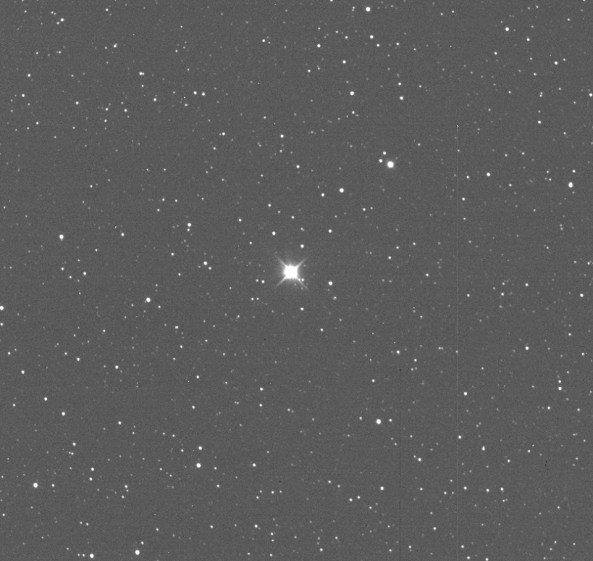
The nova has brightened enough that one can see it plainly without any optical aid. Our telescopes here at the school are no longer able to image the star without their cameras getting overwhelmed. Here is a 30 second exposure with the robotic observatory’s 10″ RC:

nova2013del081713


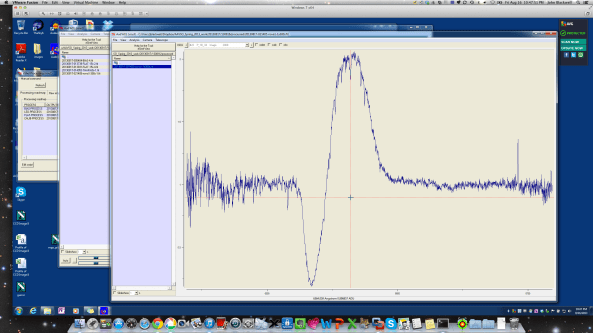
The star also is a prime candidate for small telescope spectroscopy, so I opened our Echelle spectrograph last night and grabbed high resolution from 400-700nm. Here is the H-alpha range. That is a nova alright!

Nova H-a

Possible Nova in Delphinus

Some interesting astronomy events got a lot of people stirring last night. A potential nova has been discovered in the summer constellation Delphinus. The discovery goes to Koichi Itagaki of Yamagata, Japan, using 0.18-m reflector + unfiltered CCD. When I went out last night to check it out, it was plainly visible as something new and unexpected at the end of Sagitta (the Arrow) and to the north of Delphinus. Here’s a finder for you taken with a D7000. It’s a pretty wide field which would be ok for binoculars. Note the positions of the Coat Hanger asterism and Delphinus. It’s an easy find!

Possible nova in Del

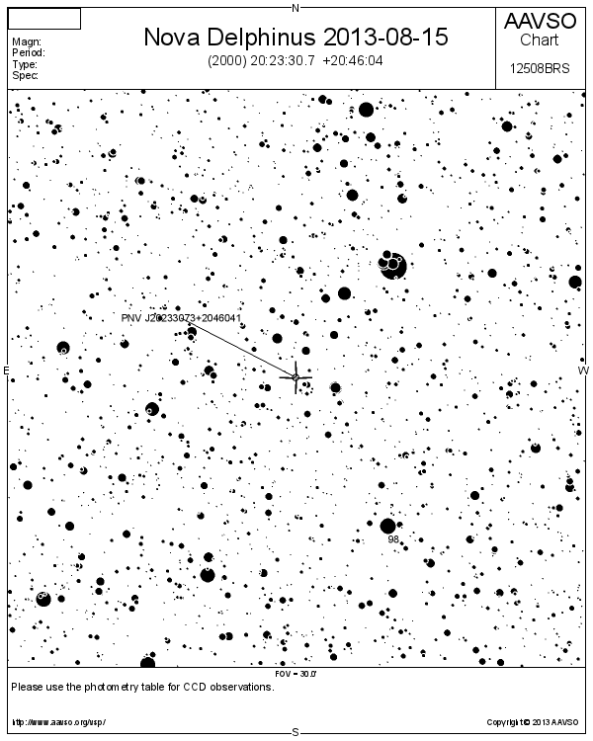
For a smaller field of view, you can go to the AAVSO website and make a plot of the area like this one which is on the 30′ scale for wide field CCDs like that in our Robotic Telescope at the Academy.

aavso finder for possible nova del

I was totally surprised to find the star getting brighter, so bright that in under an hour, I was unable to use a photometric filtered CCD to image it without maxing out the CCD. Oh well!   Enjoy everyone, and clear skies to you!


A Week in Review: NITARP 2013

This has been a fine week for collaboration and discovery. This year our NITARP group contains three teachers, four including myself as the mentor teacher, and eleven students from four states: Tennessee, Wisconsin, New York, and Connecticut.  Our project has been to utilize data from the GALEX (Galaxy Evolution Explorer) and SDSS (Sloan Digital Sky Survey) to determine correlations between Seyfert galaxy luminosities and their temperatures. Our abstract:

Data from the Sloan Digital Sky Survey (SDSS) and the Galaxy Evolution Explorer (GALEX) satellite will be used to extend the work of the 2010 and 2012 NITARP teams in demonstrating a hypothesized correlation between the luminosity and color (temperature) of the accretion disk within Type I Active Galactic Nuclei (AGN). The 2012 NITARP team was successful in finding a trend in the UV luminosity and color of the AGN in Type I quasars, however the sample size was not sufficient in demonstrating a substantial correlation. More data are needed to see if a more substantial correlation exists; therefore, data from less luminous AGN must be used. Our project will attempt to investigate whether a more significant trend is revealed when Type I Seyfert galaxies with redshifts 0.1 < z < 0.5 are added to the 2012 team’s quasar sample.

We spent this week pouring over the data and making our initial analysis of the MANY plots that we have generated. The group has achieved a notable synergy, which, I believe, comes from all being together for the week, largely in the same space, a large work area within the NASA IPAC building on the Caltech campus in Pasadena. When the day is in progress, the mutterings and discussions between people are just roll right along. At the end of the day, the work “ends” and relaxation mode begins. Some of the post-work activities this week have included some time at the beach, the end of Route 66 on Santa Monica Pier, touring through the main drags in Hollywood, visiting Old Pasadena, touring Caltech, and catching up with friends in the area. I love the Caltech canpus and have run into a couple of alumni here this week. The campus is in full glory with an 85F dry heat, sunny days and everything in bloom. That citrusy smell abounds with other flowers making themselves known: honeysuckle among them. The olive trees have just ripening dark fruit on their branches. Hummingbirds zip in and out of the many flowering trees and the yuccas.

Today is our last day: we aimed to get the students to mingle a bit more by working to finish off the various plots we need for analysis. We’re also aiming to wave at Saturn for the largest ever global scaled photobomb,,,, more on that here:  http://saturn.jpl.nasa.gov/news/waveatsaturn/viewing/

‘Nuff said. See you all back in New Hampshire, soon enough!


June 2013 Exeter Astronomy Education Conference

It is that time again! I will be hosting another astronomy education conference starting this weekend! The weeklong meeting will allow astronomy educators from around the USA to discuss and try various methods of teaching modern astronomy and astrophysics. Topics that have been covered in detail in the past:

  • CCD Imaging: photometry, color work, narrow band filters, astrometry, guiding, installation, design.
  • Observatory design, construction and maintenance.
  • Available software for astronomy, science, data reduction, learning and labs.
  • Required topics in astronomy.
  • Best practices in astronomy education, pretesting, post-testing, assessment.
  • Teaching astronomy in difficult situations: limited budgets, light pollution, late nights out.

It is always a fun time, and generates a ton of communications following the event.  This year, we are once again full. We even had a wait list!  Stay tuned for more information as the week progresses.


May Annular Eclipse

This May also plays host to the annular solar eclipse on the 10th. This eclipse is visible from the north central portions of Australia eastwards  into the equatorial regions of the Pacific Ocean.  More information can be found in this graphic from NASA:

NASA Eclipse May 10 2013

NASA Eclipse May 10 2013

eta Aquarid Meteor Shower

This May hosts another occurrence of the eta Aquarid shower. This shower often gives a reasonable 60 meteors per hour from dark sky locations. If you are in an urban area, then, well, you will not see many if any meteors at all. My highest recommendation is that you seek out a location at least a couple of hours away from major cities into dark country sites. Bring s comfortable lounge chair and some coffee, then spend the night looking up without any telescopes or binoculars. One common misconception is that you need a telescope to see showers. While there is a special area of study for telescopic meteors, most showers are just fine with the unaided eyeball as your instrument.  More information about this particular shower here: http://www.spaceweather.com/meteors/etaaquarids/etaaquarids.html