Comet C/2023 A3 (Tsuchinshan-ATLAS)

This past month has certainly been spectacular for astronomical events. Aurorae have graced our skies with tremendous activity, Saturn is back to the early evening, as is Venus, and now a comet. The comet, C/2023 A3 (Tsuchinshan-ATLAS) was noted as being the comet of the century, but reservations must always been taken when making such predictions. This was a good comet, but not nearly as spectacular as NEOWISE (C/2020 F3), Comet McNaught, Hale-Bopp, or Comet Hyakutake (C/1996 B2)… all of which were tremendous and easily seen without optical aid. C/2023 A3 was nice but bright only for a brief few days while it was in the glare of the Sun near sunrise then just after sunset. As of this writing, it is rapidly fading though still viaible with small telescopes.

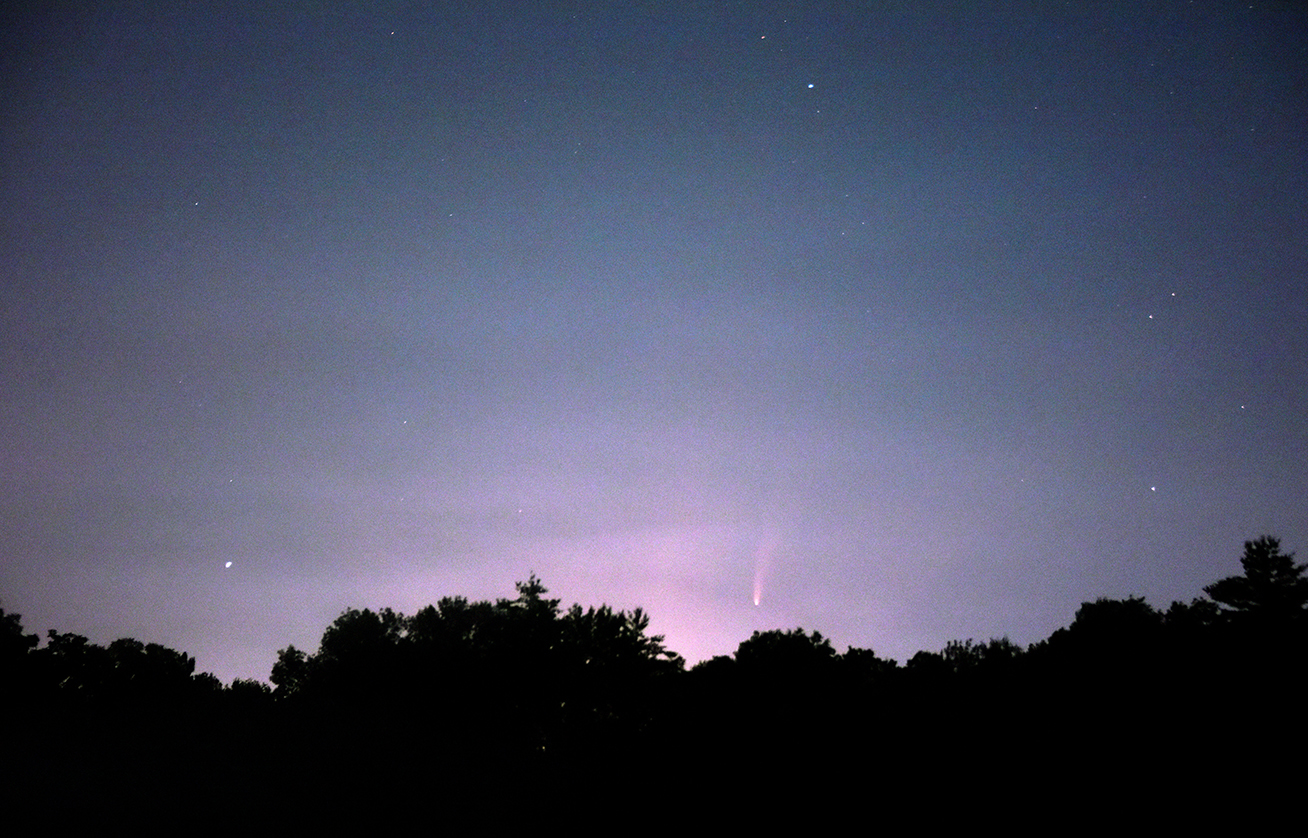
Our first view of the comet here in southern New Hampshire, was on the early evening of 12 October 2024 as it made its way around the Sun and approached Earth. We were able to see it just after sunset from the tallest building on campus, the Library. Looking west, it was only visible for about 30 minutes, but easily photographed with a telephoto.

Comet C/2023 A3 (Tsuchinshan-ATLAS)

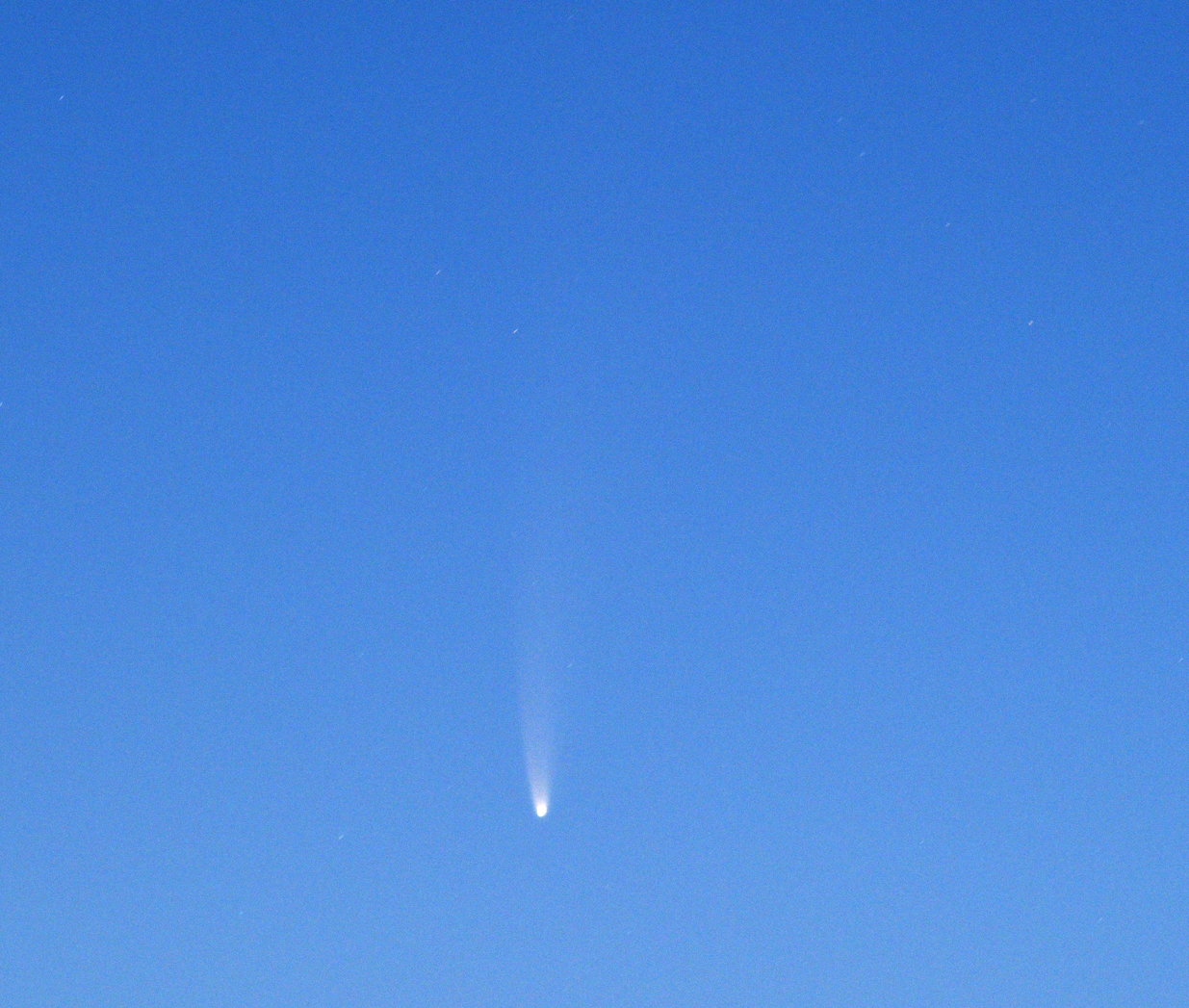
By 17th October the comet was up for a longer period but was already fading. We captured a lot of imagery this evening with a group of students and faculty by the Hill Bridge looking back to the southwest over the Field House.

Comet C/2023 A3 (Tsuchinshan-ATLAS)

Note that the anti-tail is faintly visible in the above image.

By 18th October the comet was considerably higher in altitude and even fainter. I was unable to see it without a pair of binoculars. The comet was still not visible to the observatory domes. Image below.
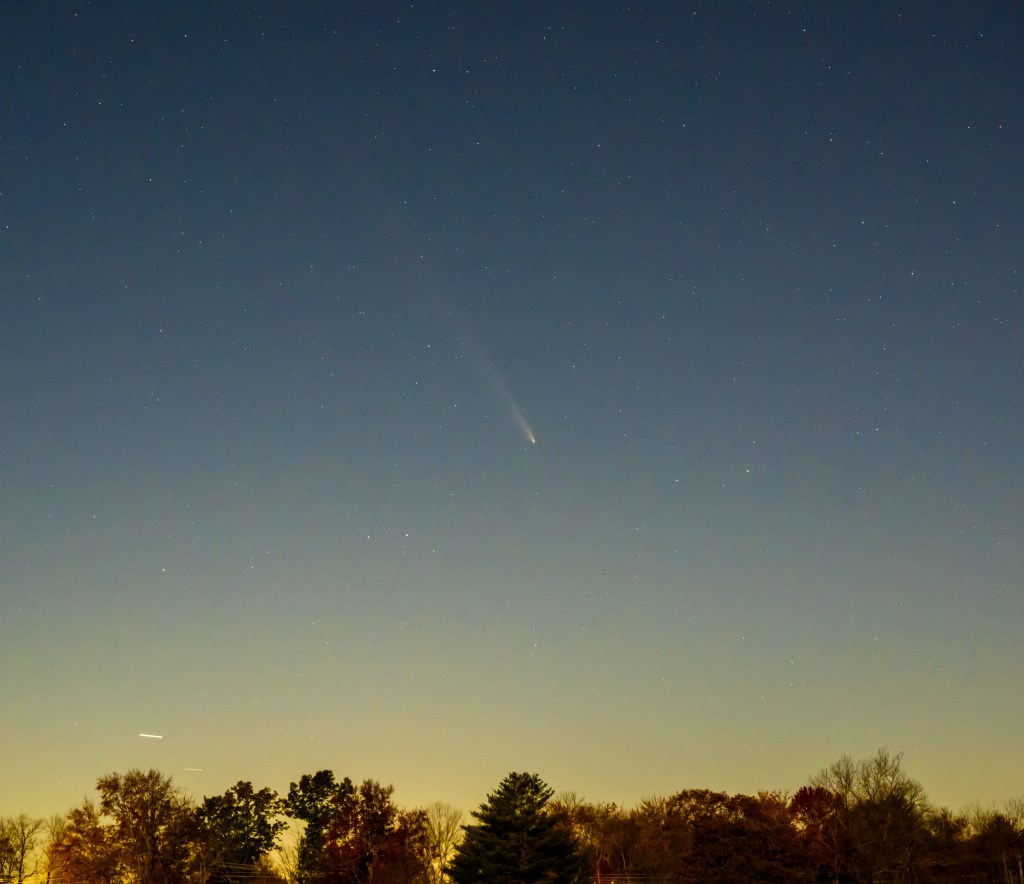
Comet C/2023 A3 (Tsuchinshan-ATLAS)

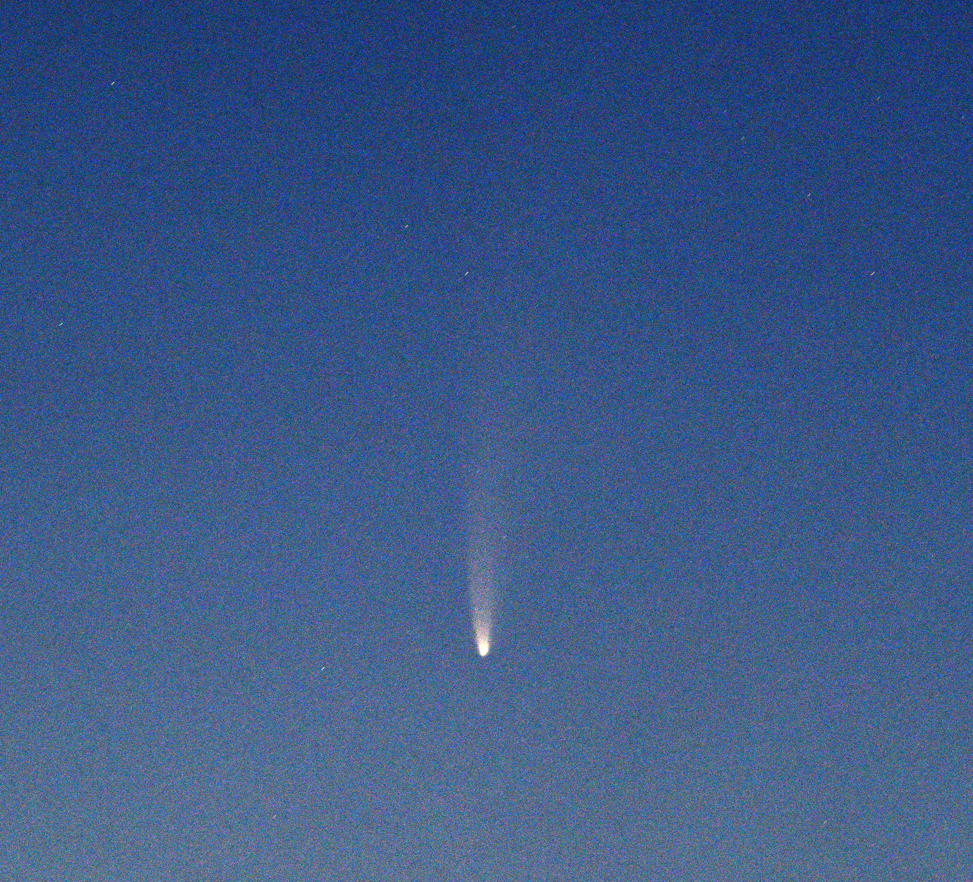
On 24th October, the comet had risen enough to be visible in the 0.7m telescope, so we gave it a go and imaged in Lum and RGB for the following close-up images. These are about 25×25 arc-minutes in dimension. Each is a 20 minute total integration comprised of ten, 2-minute integrations. One is summed and shows the stars as a series of points giving a good indication of the comet’s rapid movement relative to the background stars. The other image is a median which removes the stars and allows one to enjoy the comet’s details without distraction.
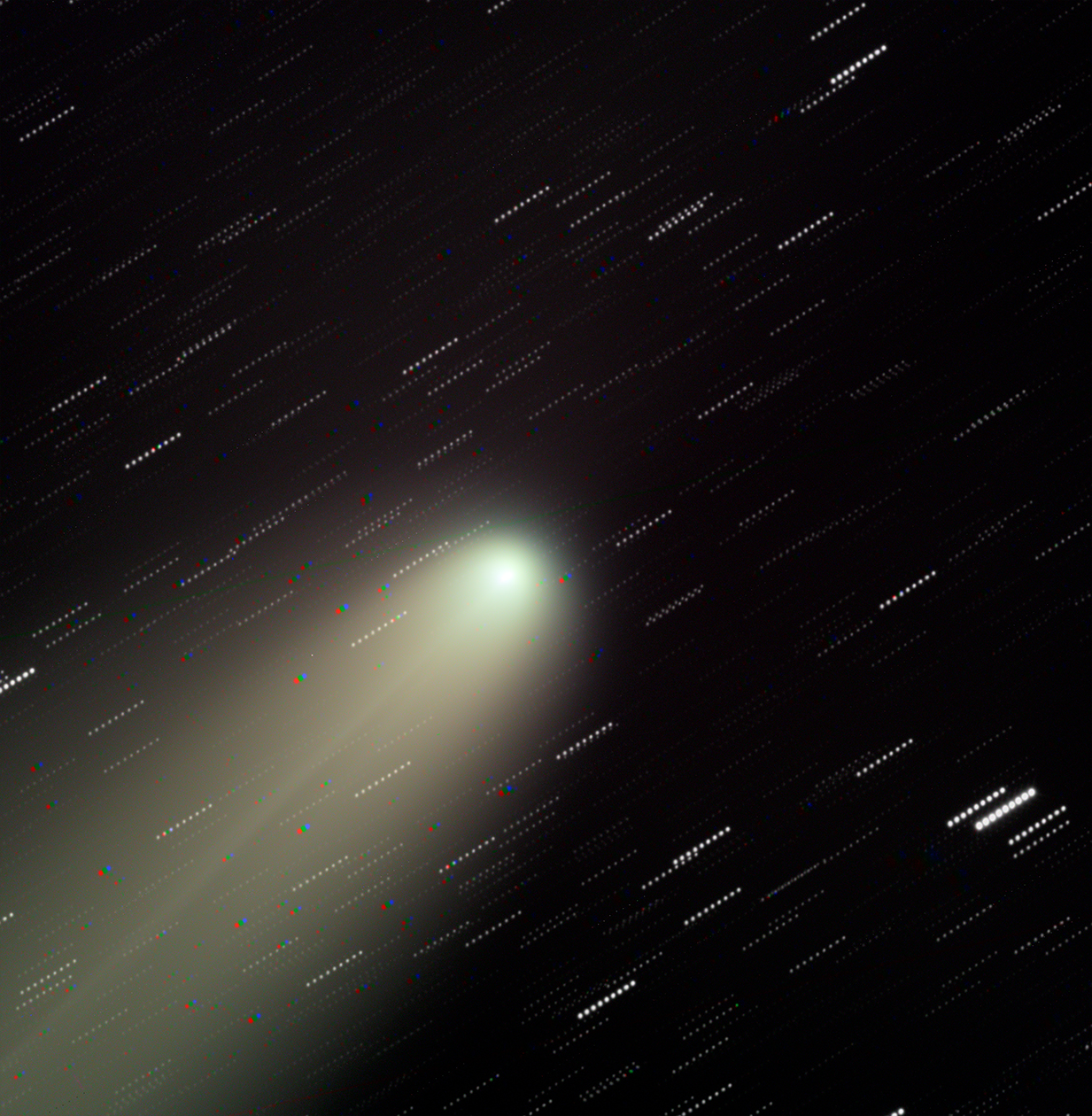
Comet C/2023 A3 (Tsuchinshan-ATLAS)

Comet C/2020 F3 NEOWISE the July 2020 Surprise

This has been quite a year. Now, add to this a bright new comet, and it gets a little better, yes? Comet C/2020 F3 NEOWISE: Named after the Wide Field Infrared Survey Explorer’s asteroid hunting mission [https://neowise.ipac.caltech.edu/], this comet has become visible to the unaided eye, and, for now, is a morning object rising just before the Sun in the northeast sky. By the week of July 13th, the comet will be more of an early evening object, and it should also be getting fainter as it heads both away from Earth and the Sun.

Weather here in New Hampshire is not forgiving to astronomers. In July we typically have high humidity and heat. Add to that some vertical temperature instability, and thunderstorms will be the rule followed by wet foggy mornings once dew point is reached. We did have one clear morning this week, and that allowed for some quick imaging of comet NEOWISE. Be sure to click on the images to see in larger format.

Equipment used:

  • Nikon D-810a with 28-300mm zoom lens at 150mm at f/3.5 and Optolong L-Pro light pollution reduction filter.
  • Nikon D-810 with 300mm telephoto at f/4.
  • Tripods with slow motion controls: untracked.

Those looking to spot the comet should bring with them a pair of binoculars and the information provided in this article from Sky & Telescope. Be sure to find a viewing location away from ground fog, and with a low horizon.  A Bright New Visitor: How to Spot Comet NEOWISE [https://skyandtelescope.org/press-releases/new-bright-visitor-comet-neowise/]

Comet C/2020 F3 NEOWISE

Comet C/2020 F3 NEOWISE

Comet C/2020 F3 NEOWISE

Comet C/2020 F3 NEOWISE

Comet C/2020 F3 NEOWISE

Comet C/2020 F3 NEOWISE


A New and Potentially Bright Comet!

Don Machholz, Shigehisa Fujikawa and Masayuki Iwamoto have confirmed a new comet which might very well become bright enough to see without optical aid. Stand by for updates here in the coming days as the orbital elements and ephemeris are corrected. The comet has been designated:

MPEC 2018-V151: COMET C/2018 V1 (Machholz-Fujikawa-Iwamoto)

More information from the Minor Planet Center here: https://www.minorplanetcenter.net/mpec/K18/K18VF1.html?fbclid=IwAR2ZmjuWzNVq4QQb4mZNGeVtJdyEhnjZEgmyj08SsUtCcTL_NFqkq5bRUFc

A Winter Comet: 46P/Wirtanen

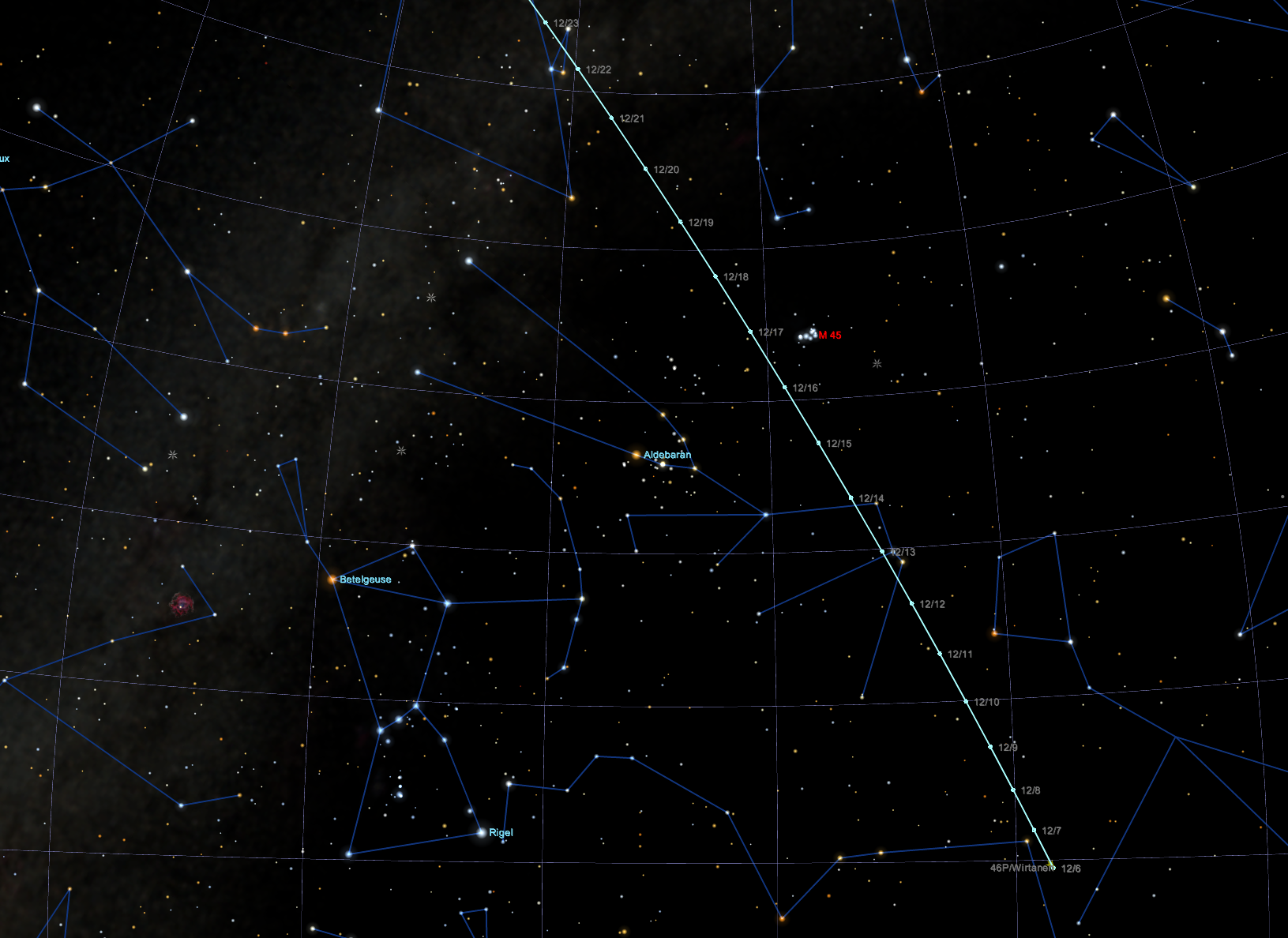
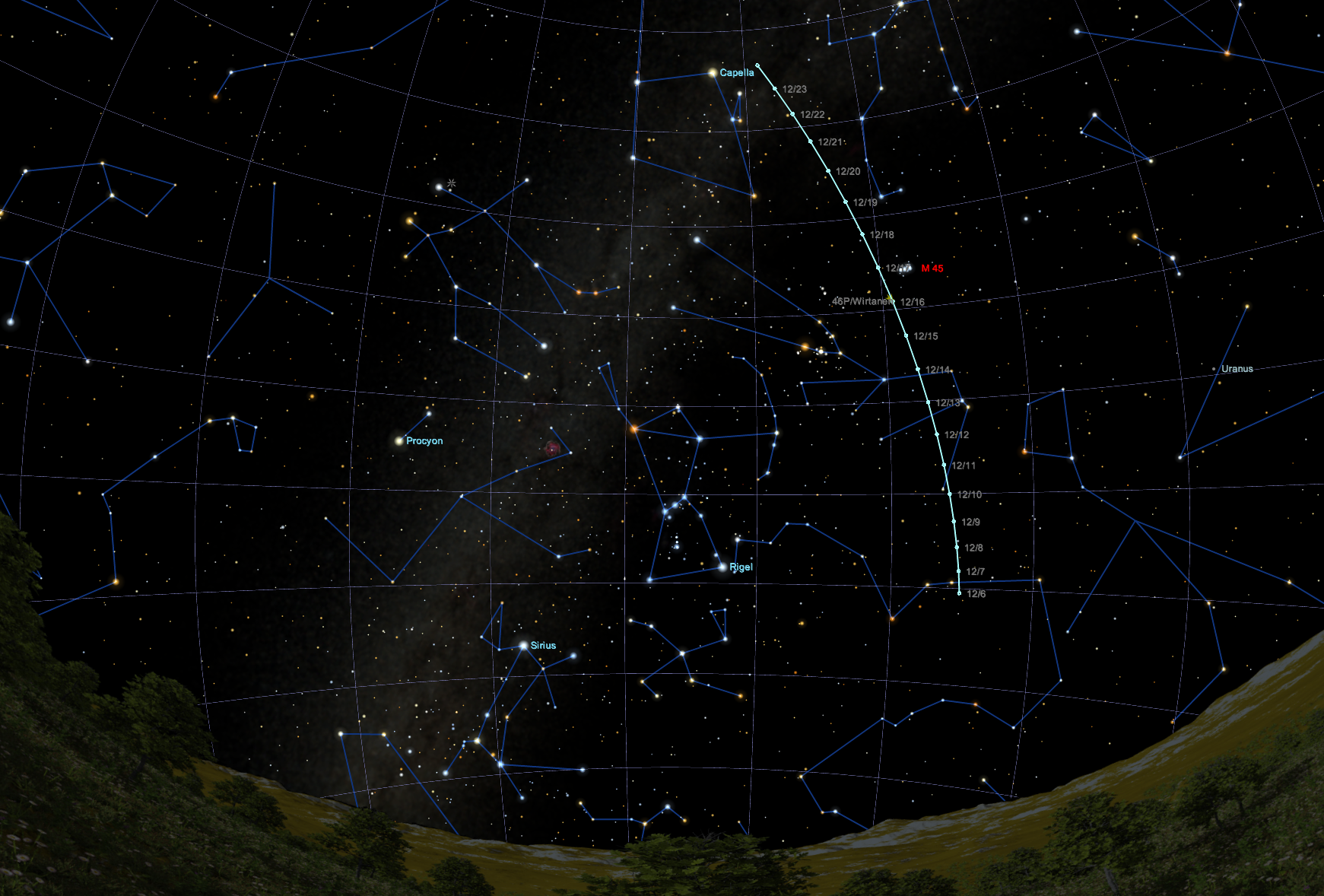
It appears that we might just have a bright comet for the end of 2018 and into the start of 2019: Comet 46P/Wirtanen. With a short period of just about 5.4 years, this time around the Sun, it will be very close to Earth (a mere 0.07AU or 11.6 million km) and enjoying its perihelion, too….. Predictions at this stage suggest a magnitude 3 object, well within the visibility range of the human eyeball.  When and where to look?  Here is an overall map of the comet’s path through December. Note that the perihelion date in December 16th, then the comet should be near its brightest:

Comet 46P/Wirtanen throughout December 2018. (click to enlarge)

Comet 46P/Wirtanen throughout December 2018. (click to enlarge)

On the night of 16 December for mid-latitude northern observers, looking south, this is what you should see…a lovely view of Orion and surrounding constellations. The comet should be near the Pleiades, making for a fine photographic opportunity.

Looking south of 16 December. (click to enlarge)

Looking south of 16 December. (click to enlarge)