Lunar Occultation of Jupiter: 6 October 2026

This was the second occultation of the planet Jupiter within recent weeks, but the last one took place in broad daylight, much less spectacular to observe than this event which took place at nighttime. The one disadvantage was that “night” was at 4:25 in the morning for us here at Exeter, NH, USA. This made for a small audience…. myself, in a field, with a portable telescope, camera and a winter coat and hat. Portability in astrophotography is much easier than it used to be. This time around, a small refractor, a GoTo mount, a portable 12V power pack, and a DSLR were all that were needed.

Arriving at the scene, the view was already lovely: there, above the eastern horizon was Jupiter just beneath the Moon, about an hour away from the event itself. High in the sky to the south: Orion and Taurus. Rising with the Moon was Leo. The milky Way was sprawled across the sky. There were a couple of Great Horned Owls hooting in the nearby forest. Perfect!

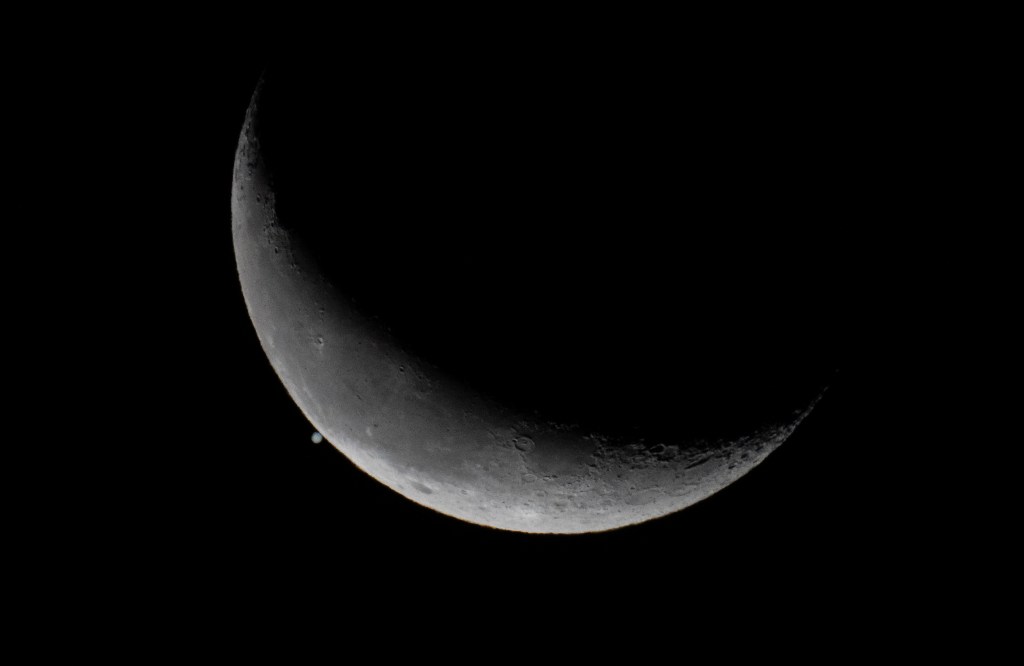
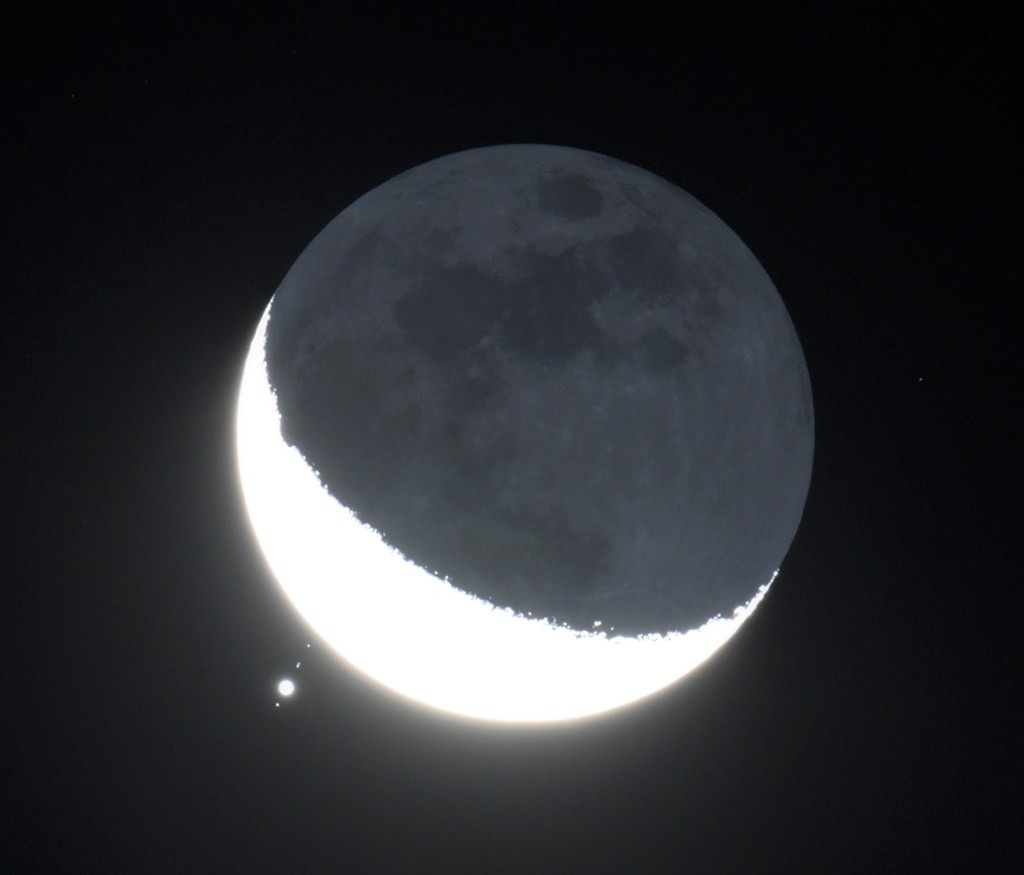
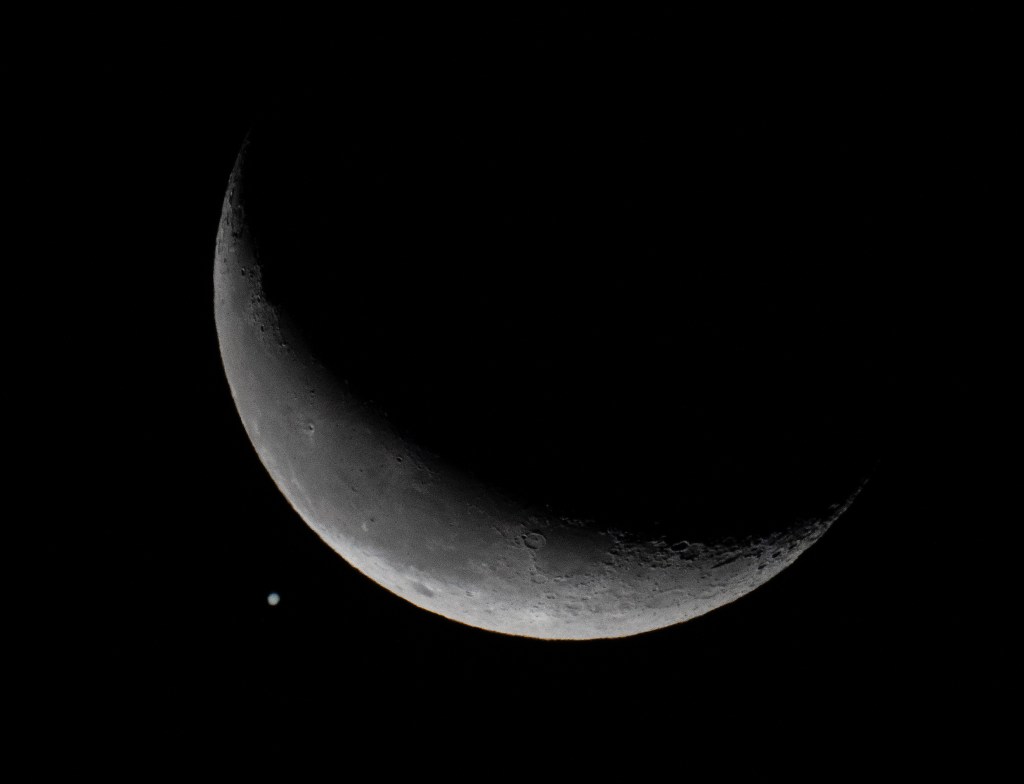
Perfect it was: seeing conditions were not absolutely the best, but they were good enough to spot the bright Galilean moons of Jupiter, and an occasional view of the major cloud bands on the planet. The Moon as a waining crescent gave a nice view of the craters and mountains that we usually don’t get to see in such a relief without being up early in the morning before sunrise. Like clockwork, the event unfolded nicely giving some good opportunity for images. Below are three:

An overexposed image to show off two neat things: The Earthshine from the Moon’s unilluminated side, and the four bright moons of Jupiter, Io, Ganymede, Europa and Callisto.

Two images exposed to show Jupiter as it approached occultation. The Moon is also well exposed. If you look carefully, one can just see the cloud bands on Jupiter.
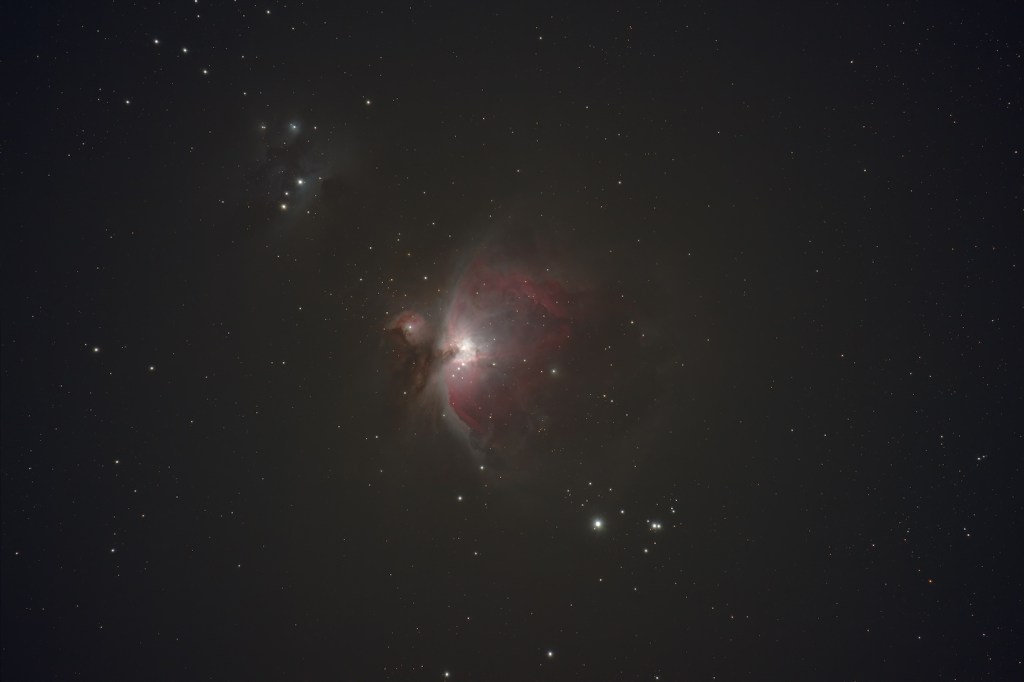
Once Jupiter was completely blocked by the Moon’s presence, being awake with stars in the sky was a real draw. I decided to spend some time gathering images of the favorite winter targets. In the case shown below, the much beloved Orion’s Nebula (Messier 42) was a good one. It was highest in the sky (culminating) and a bright enough target that a few minutes of exposure time would grab a good image.
Comet C/2023 A3 (Tsuchinshan-ATLAS)

This past month has certainly been spectacular for astronomical events. Aurorae have graced our skies with tremendous activity, Saturn is back to the early evening, as is Venus, and now a comet. The comet, C/2023 A3 (Tsuchinshan-ATLAS) was noted as being the comet of the century, but reservations must always been taken when making such predictions. This was a good comet, but not nearly as spectacular as NEOWISE (C/2020 F3), Comet McNaught, Hale-Bopp, or Comet Hyakutake (C/1996 B2)… all of which were tremendous and easily seen without optical aid. C/2023 A3 was nice but bright only for a brief few days while it was in the glare of the Sun near sunrise then just after sunset. As of this writing, it is rapidly fading though still viaible with small telescopes.

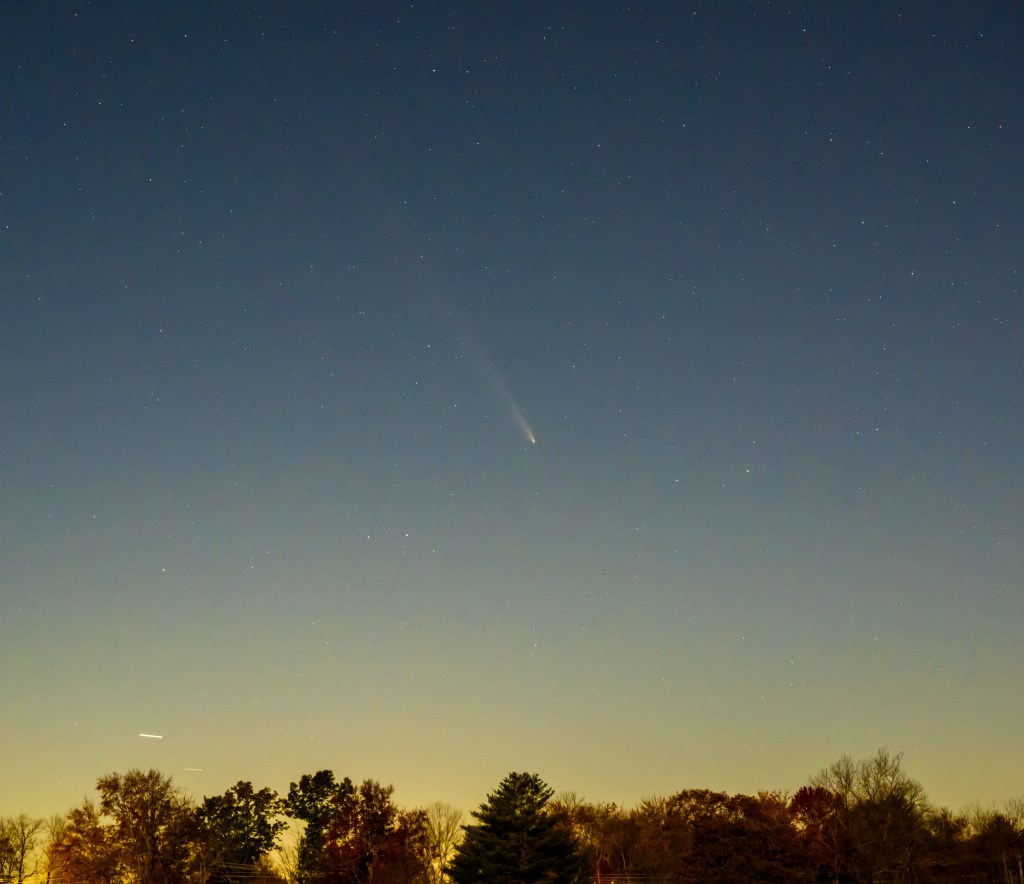
Our first view of the comet here in southern New Hampshire, was on the early evening of 12 October 2024 as it made its way around the Sun and approached Earth. We were able to see it just after sunset from the tallest building on campus, the Library. Looking west, it was only visible for about 30 minutes, but easily photographed with a telephoto.

Comet C/2023 A3 (Tsuchinshan-ATLAS)

By 17th October the comet was up for a longer period but was already fading. We captured a lot of imagery this evening with a group of students and faculty by the Hill Bridge looking back to the southwest over the Field House.

Comet C/2023 A3 (Tsuchinshan-ATLAS)

Note that the anti-tail is faintly visible in the above image.

By 18th October the comet was considerably higher in altitude and even fainter. I was unable to see it without a pair of binoculars. The comet was still not visible to the observatory domes. Image below.

Comet C/2023 A3 (Tsuchinshan-ATLAS)

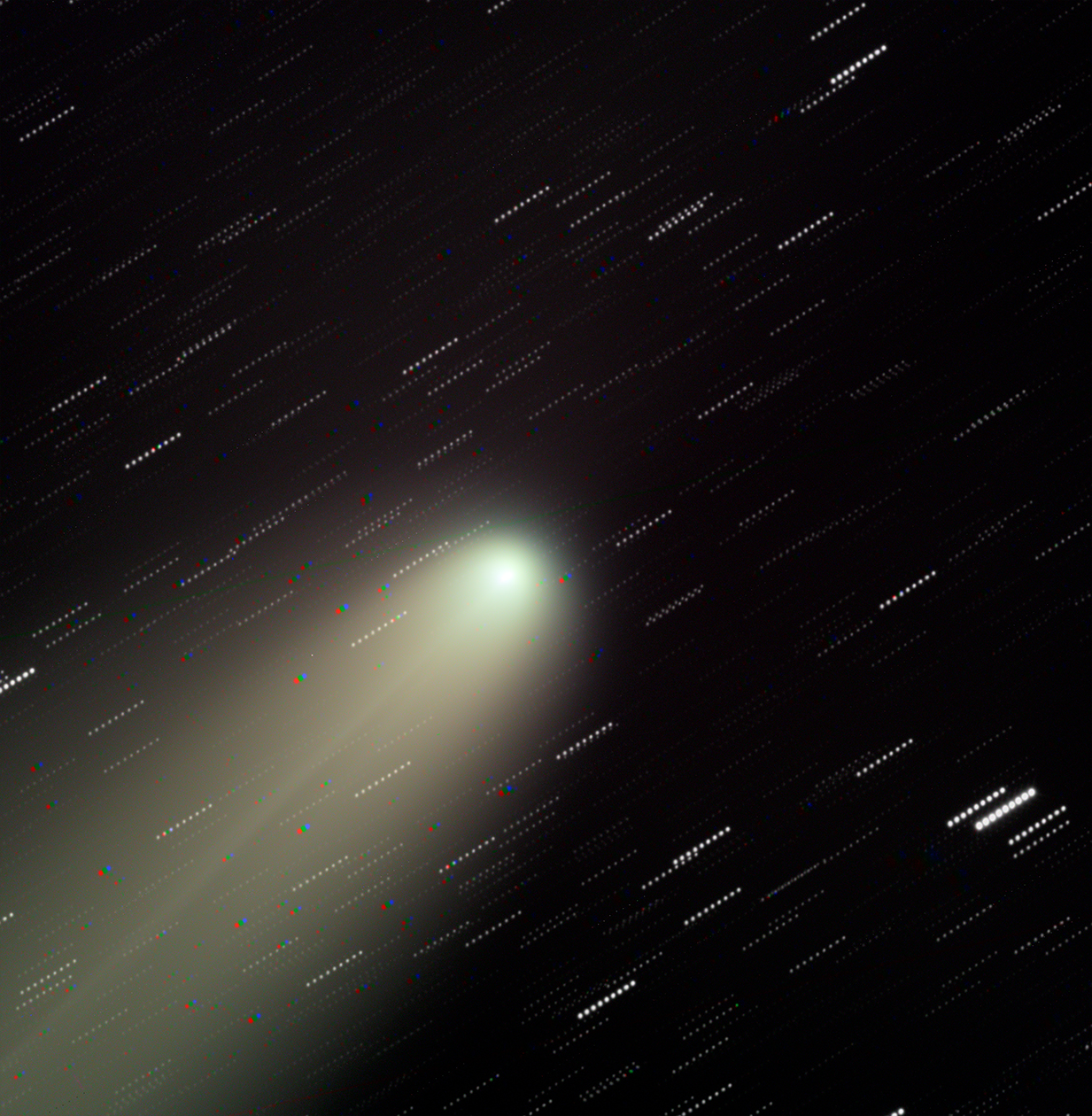
On 24th October, the comet had risen enough to be visible in the 0.7m telescope, so we gave it a go and imaged in Lum and RGB for the following close-up images. These are about 25×25 arc-minutes in dimension. Each is a 20 minute total integration comprised of ten, 2-minute integrations. One is summed and shows the stars as a series of points giving a good indication of the comet’s rapid movement relative to the background stars. The other image is a median which removes the stars and allows one to enjoy the comet’s details without distraction.

Comet C/2023 A3 (Tsuchinshan-ATLAS)