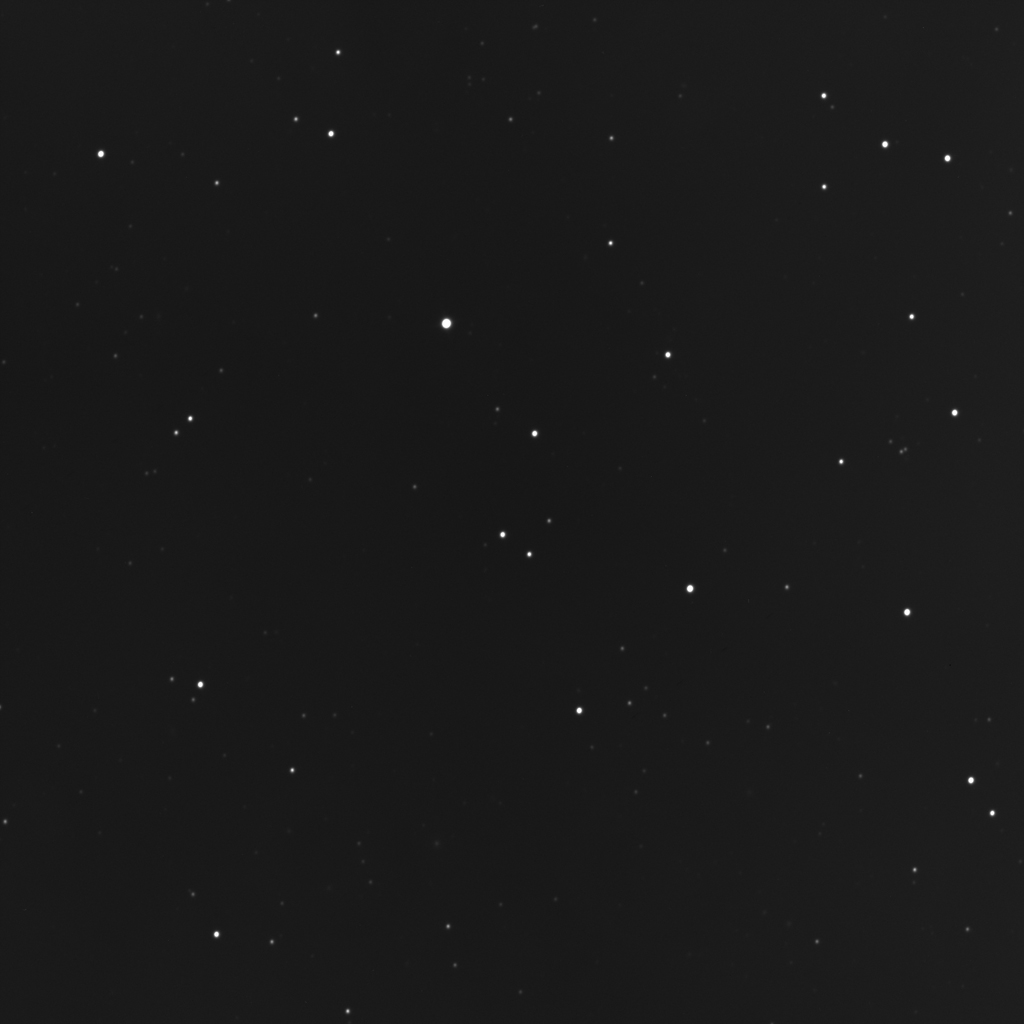
8 April 2024 Total Solar Eclipse

There are a lot of sites out there to help you get going with eclipse planning this time around. This will give you a lot of links and go-to sites for that information. Happy eclipse viewing!

NASA Eclipse 8 April 2024 Map of Globe
Courtesy NASA

Planning: at this time, getting to and from remote locations is going to be challenging at best. Most flights around the eclipse date are filled. Hotels are also booked. If you are within driving range, be very aware that your drive times will be greatly increased traffic congestion. Our experience has been that getting to a site one or two days early is the easy part if you drive in.  Driving out is next to impossible: again, wait a day or two to leave.  People will try to part anywhere they can, from shopping center lots to the side of the highway. Be safe. Be kind to people. Crowds are challenging.
Planning: 2023 October 14 Annular Solar Eclipse

Not eclipses are total. Many are partial, and some are annular. An annular eclipse takes place when the angular size of the Moon in the sky is smaller than the angular size of the Sun in the sky. What makes this happen? Distances! The further away something is from your vantage point, the smaller is appears. During the eclipse of 14 October 2023, the Moon is close to its apogee, its furthest distance away from Earth in its orbit (remember that the Moon’s orbit is significantly elliptical).  During an annular eclipse, if you are on the eclipse path, you will see the smaller Moon cover the Sun, but not completely. A small thin ring of the Sun will still be visible around the edge of the Moon.  Be very careful! Annular eclipses are NOT safe to look at without proper solar filters or instrumentation!

More on the safe observing practices here: Annular Eclipse Safety

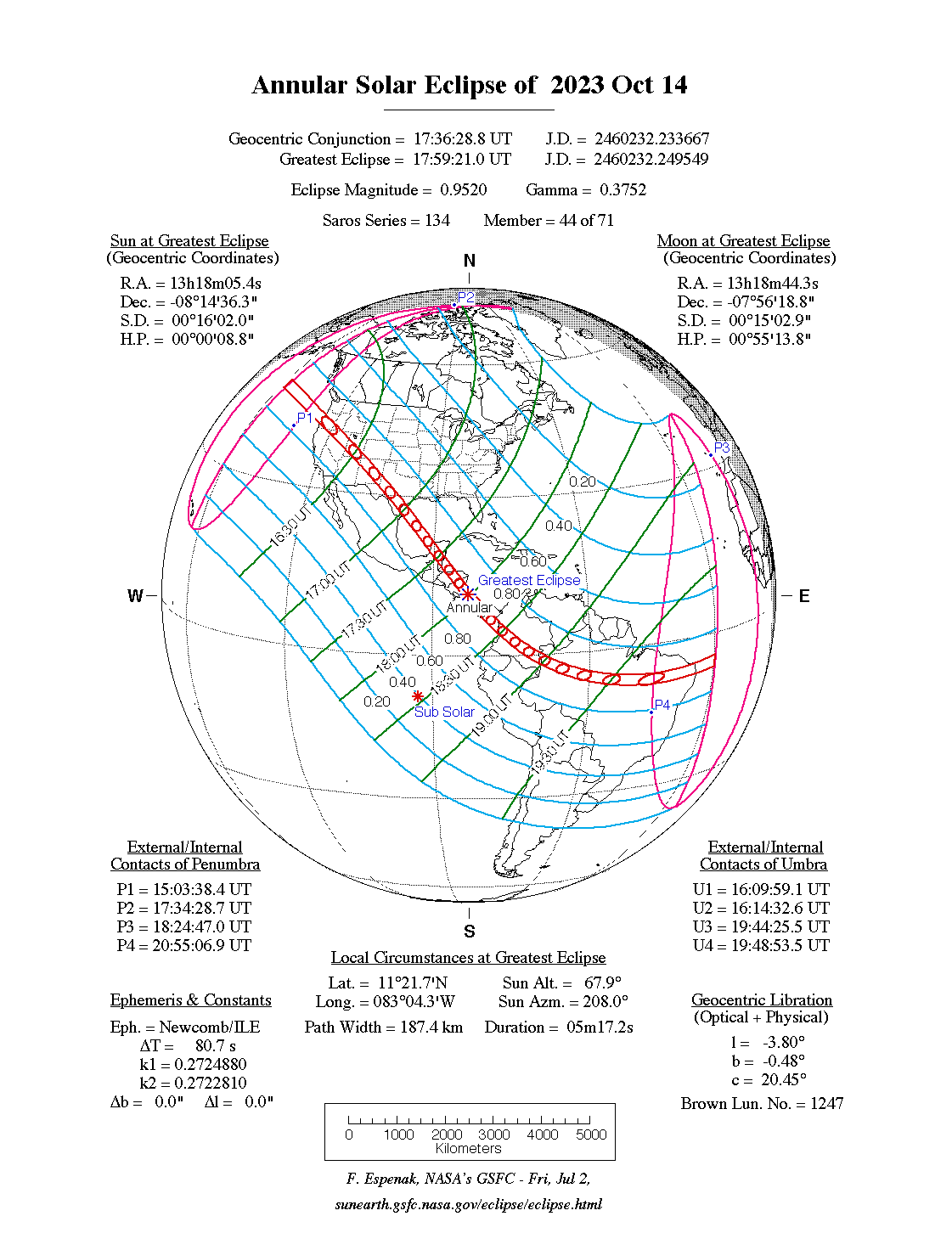
The path of maximum eclipse passes from Texas through to the Pacific Northwest on this occasion. Others across the Americas will see a partial eclipse, an equally exciting opportunity. The chart below (NASA) shows the path.

14 October 2023 Annular Eclipse Map

A reminder: Observe safely. Even when this eclipse is in full annular mode, it is not safe to look at. It is also not safe to aim your camera at for any length of time, as your lens system could suffer damage, as could the sensor and shutter mechanism. Use proper filters!

When to see it?  This website will help you plan your observing schedule with its interactive map. https://science.nasa.gov/eclipses/future-eclipses/eclipse-2023/where-when/

Safe and Happy Observing!  

Springtime Nova: V1716 SCO

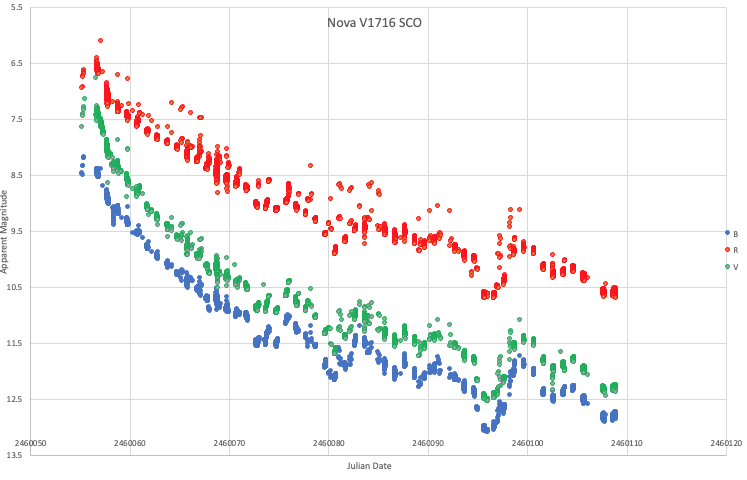
Advanced astronomy classes this spring had the opportunity to hone their skills at image data extraction and analysis with a telescope we have been operating in the southern hemisphere. This spring, a classical nova erupted, reaching V magnitude ~ 6.7 or so before fading. We collected data every clear night in photometric filters, V, B and R for analysis and submission to the AAVSO. When done, students had correctly analyzed 176 data points and submitted those as observer GPE (Grainger Phillips Exeter), our AAVSO initials. Below is a plot of the V, B and R data from the AAVSO which includes our data and those from all the other observers who took part in observing this star.

Light curve of AAVSO data for the nova V1716 SCO.

Apparent magnitudes in V, B and R are on the ordinate. Julian Date is on the abscissa. The colors denote filters used: Red = R, Green = V, and Blue = B photometric filters. We acknowledge with thanks the variable star observations from the AAVSO International Database contributed by observers worldwide and used in this research.

Supernova in M-101

This May we were in a fortunate situation: clear skies and a new supernova to observe. The advanced astronomy classes had the opportunity to reduce and analyze the data and feed their results to the AAVSO. Below is a 300 second lum-filter integration of the region of SN 2023ixf in Messier 101. At peak, this object reached an astounding magnitude in V ~ 10.8

Messier 101, the Pinwheel Galaxy, and the supernova are 20.9 million light-years distant. The supernova was confirmed as a Type II meaning it was once a very massive star which, at the end of its “life cycle” had expanded into a red supergiant and imploded resulting in the explosion phenomena you see here.

10 June 2021 Annular Solar Eclipse

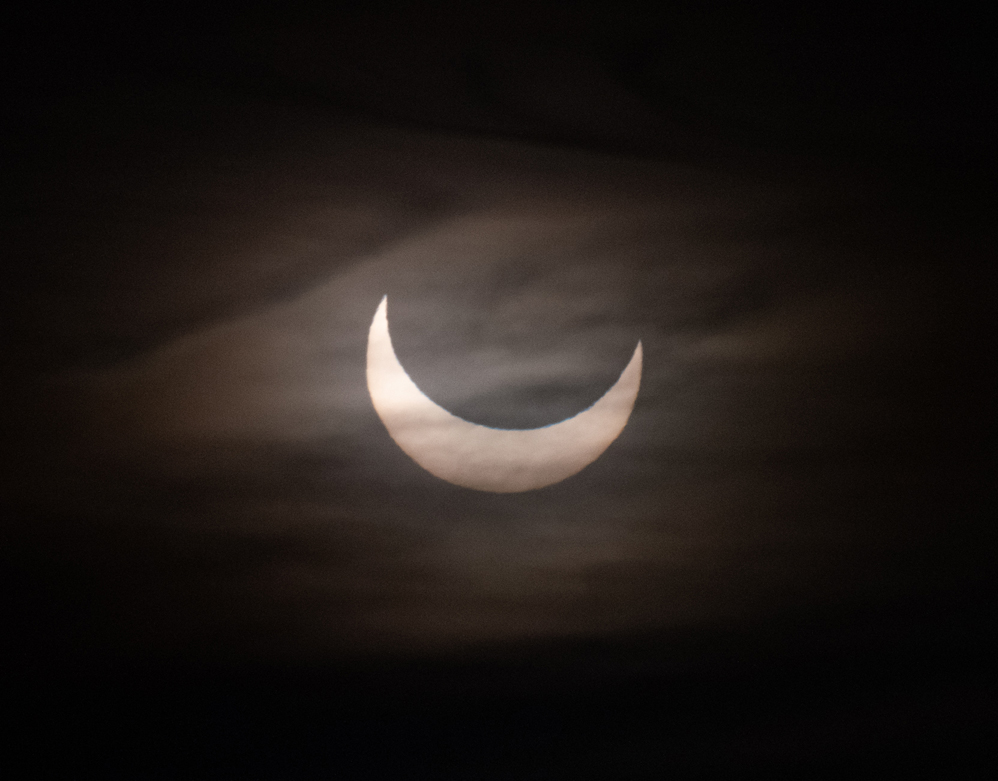
From NH this was a partial eclipse, but we had good weather and the opportunity to watch the sunrise with the eclipse already in progress. The choice location was one of many spots along the NH seacoast. We chose North Beach in Hampton which had easy to reach parking and plenty of locations to settle a tripod, telescope and camera.

Brought to the event was a Questar 3.5″ telescope with full aperture solar filter for visual use and a Nikon D810, 500mm telephoto and full aperture solar filter for video and images.

We arrived just after 4:15am EDT: nobody was there! Just us, the stars and the eerie red glow to the northeast. Jupiter and Saturn gave us wonderful pre-sunrise views through the telescope as we waited for the sun to get above the horizon. People started to arrive at about 5:00am. By 5:15am the lot was full. Clouds? Oh yes, there were clouds throughout the entire event, but we still had great chances to see and photograph the event. Here are some to enjoy:

The Orion Nebula: Star Forming Region and Splendid Winter Target

The Orion nebula, also known as Messier 42 (M-42), is one of the most splendid winter deep sky targets for amateur astronomers. It can be seen as a faint fuzzy patch for those of us with excellent vision, just below the three belt stars of the constellation Orion.

Map of Orion

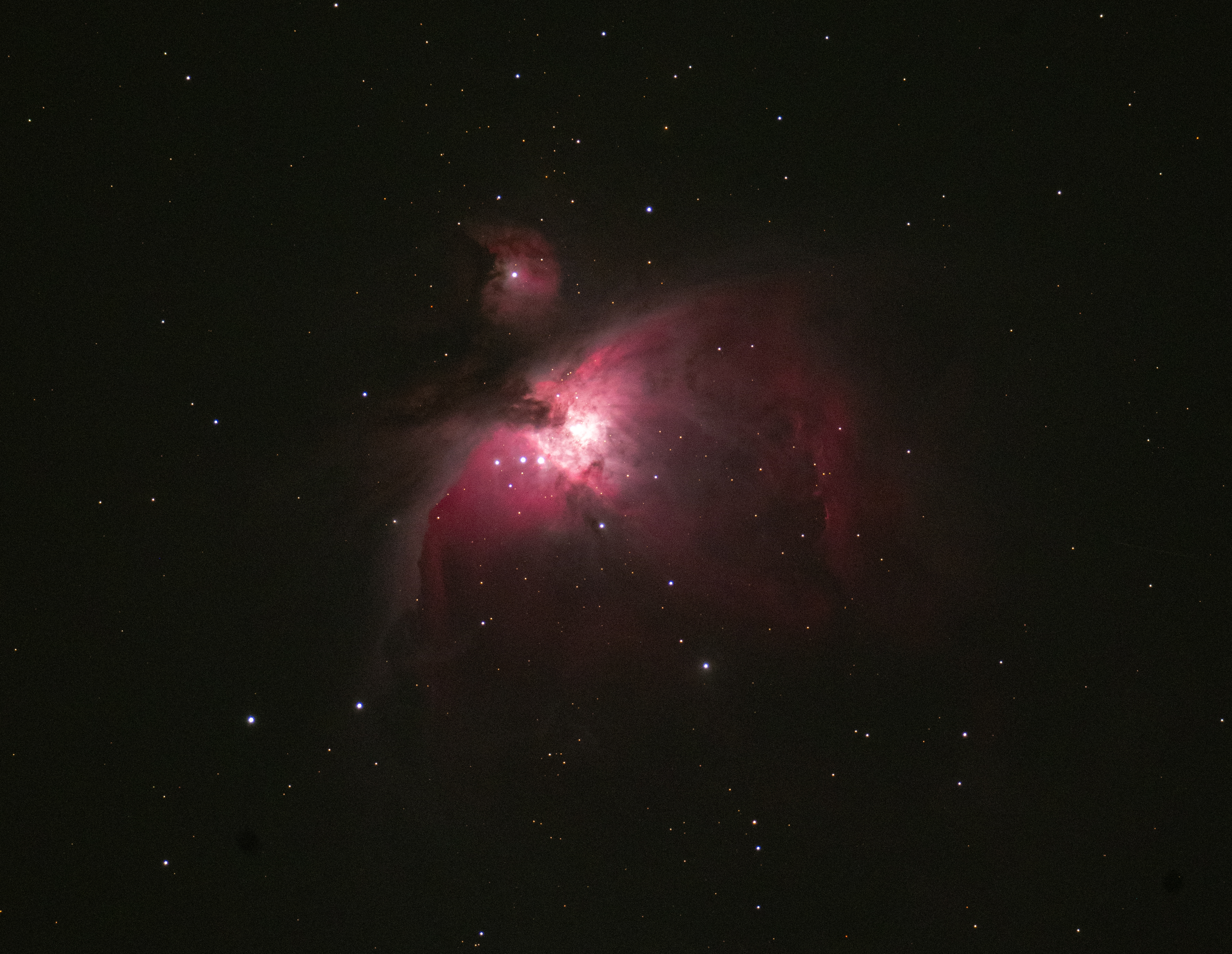
In binoculars this patch of light shows some sweeping details and groups of stars surrounding the area. Through a modest telescope, the details do start to pop out, and if using a telescope of 16 or more inches in diameter, you will start to get hints of greenish color when viewing through an eyepiece.  Unfortunately, the human eye is not the most sensitive to the red light that excited Hydrogen gas gives off (656.3nm), and the Orion Nebula outs out a lot of its light at this wavelength. As a bright nebula, it has become a favorite target for budding astrophotographers: even a small telescope and short exposures of a minute or so will show some very satisfying detail. Here is a color image of M-42 taken with the school’s Takahashi FC-125, a 125mm (5″) diameter refractor. The camera was a Nikon D-810a DSLR, their version of the D-810 but without their IR blocking filter. This allows a much higher sensitivity to the Hydrogen emission lines at 656.3nm. The “a” means astronomy in Nikon lingo. This image is constructed with three separate 60 second exposures, cleaned up by removing bias, dark and flat fields, then merged together to show the bright inner details along with the fainter outer regions of the nebulosity.

Orion Nebula

The nebula itself is some 1344 light-years from our Solar System and is about 24 light-years across. It is a well studied star forming region, with some of its young stars forming protoplanetary disks, the precursors to solar systems.


Jupiter/Saturn Conjunction 21st December 2020

The date has come and gone, but the weather was the trickiest part of the event: we had a large cloudy set of systems across much of the northern portion of the USA, though we had almost exactly 30 minutes of clear skies here in Exeter, NH to see the conjunction in all its glory before the clouds then fog took over the evening.

Arrival at the observatory is something I just do, especially when there is an interesting or important event taking place. The day had been solidly overcast, but I was keeping watch on the NOAA GOES-East: Sector View site to see if any clear regions were headed our way. Sure enough, there was a parting in the clouds, about the width of Massachusetts, headed towards us from the southwest. I set up the camera and the telescope in the dome, pointing them both at the correct location… ready for that clear sky moment! Sure enough, the sky did clear!

Setup next to one of the observatory domes, the wide field view was lovely. With good vision, one could easily separate the two planets, Jupiter the brighter of the two, and Saturn the fainter. Here is a photo taken with Nikon D-810 and a AF-S Nikkor 1:3.5-5.6 28-300mm zoom lens, one of my favorite go-to travel lenses. The system was on a stable tripod and time-delay release was used on the shutter to prevent vibrations. The inset image is the telescopic view of the planet pair.

Moving inside the dome, I had the Takahashi FC-125 refractor setup with a Nikon D-810a at prime focus. This stem is very stable, driven on a Paramount Me and protected from the wind. Here are a couple of images taken through the telescope, one long exposure to see Jupiter’s and Saturn’s moons, and another to see some planetary detail. The seeing conditions were atrocious this evening, so no detail was really seen on Jupiter, alas. Saturn’s rings were readily visible, though.

Below is a long exposure image of the scene with all the objects labeled for identification. Those objects labeled “HIP #” are stars that happen to be in the field of view.

Below is an image from within the dome, a view looking along the telescope out the dome aperture where the conjunction was easily seen.  This photo was taken with an iPhone. The insert is the telescope’s view. You can also see the incoming clouds from the southwest which were headed to interfere with our observing plan in the very near future.

Not some 10 minutes later, this is what the observatory site looked like: a foggy mess. Only the first quarter moon was visible through the fog and clouds.

Telescope buying?! Wonderful!

This can get really complex, and, as you imagined, very expensive.  There is this sudden realization that good scopes are pricey, and the less expensive ones are, well, to be honest, not worth the cash. They end up in closets or basements.  For a first time telescope, especially for kids, I always recommend a really good pair of 8×50 or 10×60 binoculars. These get good use at night, AND during the day… bird, scenic views and the like.  If we are talking seriously into astronomy and telescope are the only choice, then go for the most scope you can afford: one with a quality heavy mount and large aperture.  My close friend Ed Ting has made a wonderful page with a load of buying tips here:  http://scopereviews.com/begin.html Do start there and work through it.  At all costs avoid the department store telescopes. They are a plague in our science with their cheap, shaky mounts and promises of ridiculously high powers 😉

Coupled with a telescope purchase is the inevitable need for some accessories. I’ll list a few here to consider:

  • A wide range of good eyepieces. These get expensive but will last a very long time. I recommend three to start, one for low, medium and high magnification. Magnification can be found by dividing the telescope’s focal length by the focal length of the eyepiece. Typical low power magnifications are on the order of 25-30x.  Medium: 75-150x. High: 200-300x. One rarely uses the high magnification. Honest!
  • A good sky atlas. Good ones can be used for eyes, binoculars and small telescopes like these options: Sky & Telescope’s Pocket Sky Atlas – Jumbo Edition and the Sky & Telescope’s Pocket Sky Atlas.
  • A red-light flashlight. A simple regular flashlight with red cellophane covering is good.
  • Maybe even a subscription to Sky & Telescope Magazine or Astronomy Magazine. These help the newcomer by projecting what good targets will be available in future months.

Stay well and enjoy clear skies!

Comet C/2020 F3 NEOWISE the July 2020 Surprise

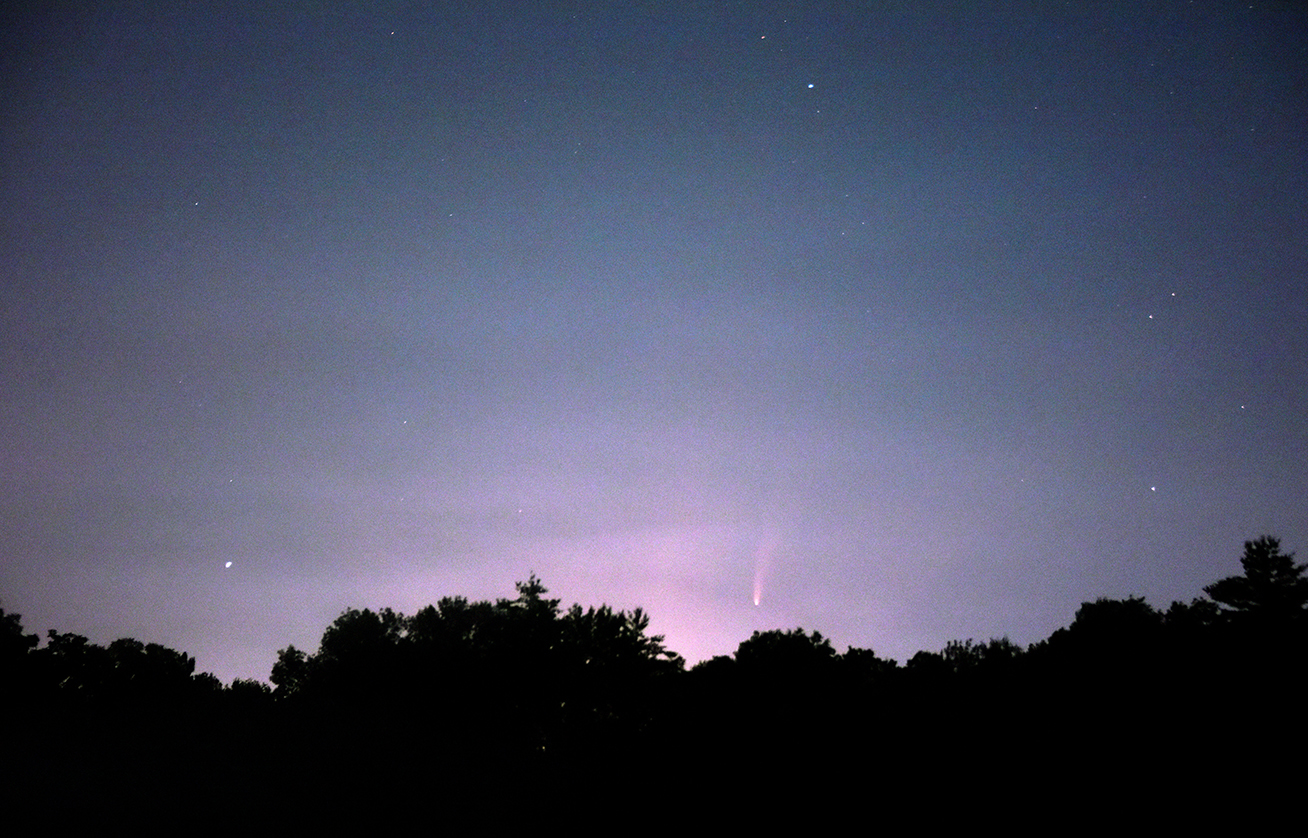
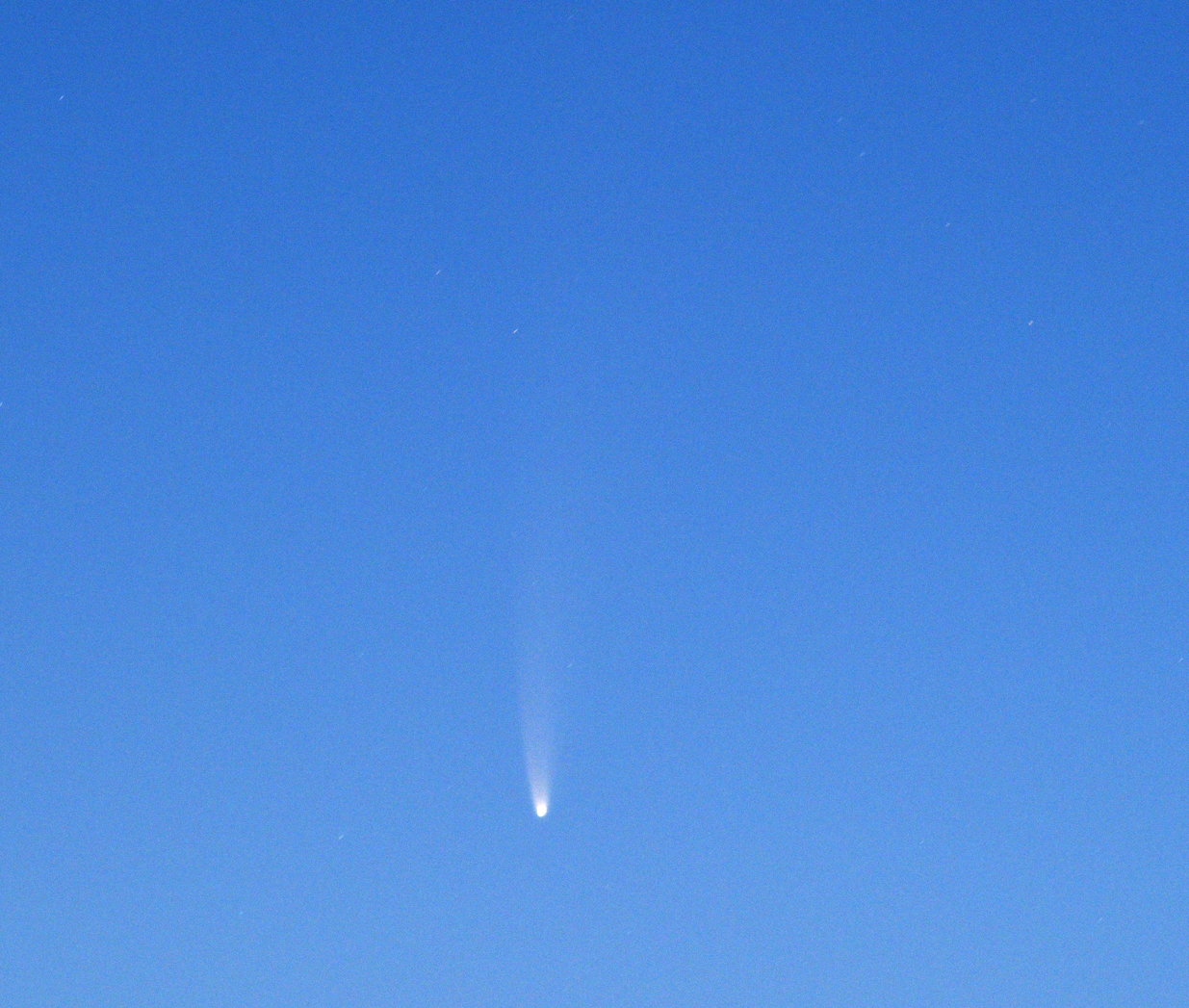
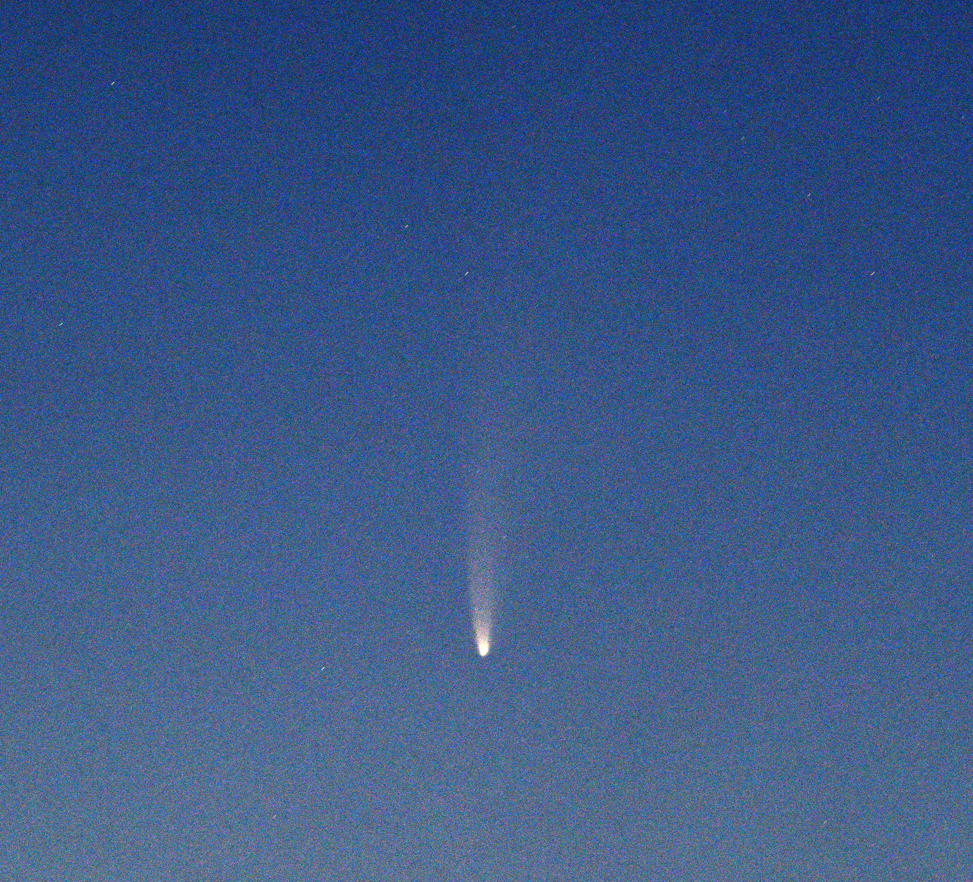
This has been quite a year. Now, add to this a bright new comet, and it gets a little better, yes? Comet C/2020 F3 NEOWISE: Named after the Wide Field Infrared Survey Explorer’s asteroid hunting mission [https://neowise.ipac.caltech.edu/], this comet has become visible to the unaided eye, and, for now, is a morning object rising just before the Sun in the northeast sky. By the week of July 13th, the comet will be more of an early evening object, and it should also be getting fainter as it heads both away from Earth and the Sun.

Weather here in New Hampshire is not forgiving to astronomers. In July we typically have high humidity and heat. Add to that some vertical temperature instability, and thunderstorms will be the rule followed by wet foggy mornings once dew point is reached. We did have one clear morning this week, and that allowed for some quick imaging of comet NEOWISE. Be sure to click on the images to see in larger format.

Equipment used:

  • Nikon D-810a with 28-300mm zoom lens at 150mm at f/3.5 and Optolong L-Pro light pollution reduction filter.
  • Nikon D-810 with 300mm telephoto at f/4.
  • Tripods with slow motion controls: untracked.

Those looking to spot the comet should bring with them a pair of binoculars and the information provided in this article from Sky & Telescope. Be sure to find a viewing location away from ground fog, and with a low horizon.  A Bright New Visitor: How to Spot Comet NEOWISE [https://skyandtelescope.org/press-releases/new-bright-visitor-comet-neowise/]

Comet C/2020 F3 NEOWISE

Comet C/2020 F3 NEOWISE

Comet C/2020 F3 NEOWISE

Comet C/2020 F3 NEOWISE

Comet C/2020 F3 NEOWISE

Comet C/2020 F3 NEOWISE


Spring is a Time for Galaxies

As the winter milky way begins to set in the west, the spring time constellations bring views into the deeper universe, much more distant than the local open clusters and nebulosity of winter skies. Last night was particularly clear and offered an opportunity to visit Leo and Virgo to see some of the brighter galactic neighbors and also something much more distant. Here are some of the images taken with the 0.7m telescope, including shots of the most distant objects we have imaged to date. To view these images well, you might elect to reduce your room lighting and adjust your monitor to see fainter shades. All the images are monochrome luminance shots. No color this time.

M-65

M-65. A spiral galaxy 35 million light-years away. Part of the Leo Triplet with M-66 and NGC 3628.

NGC 3628

NGC 3628, an edge on spiral galaxy in Leo about 3 million light-years away.

M-95

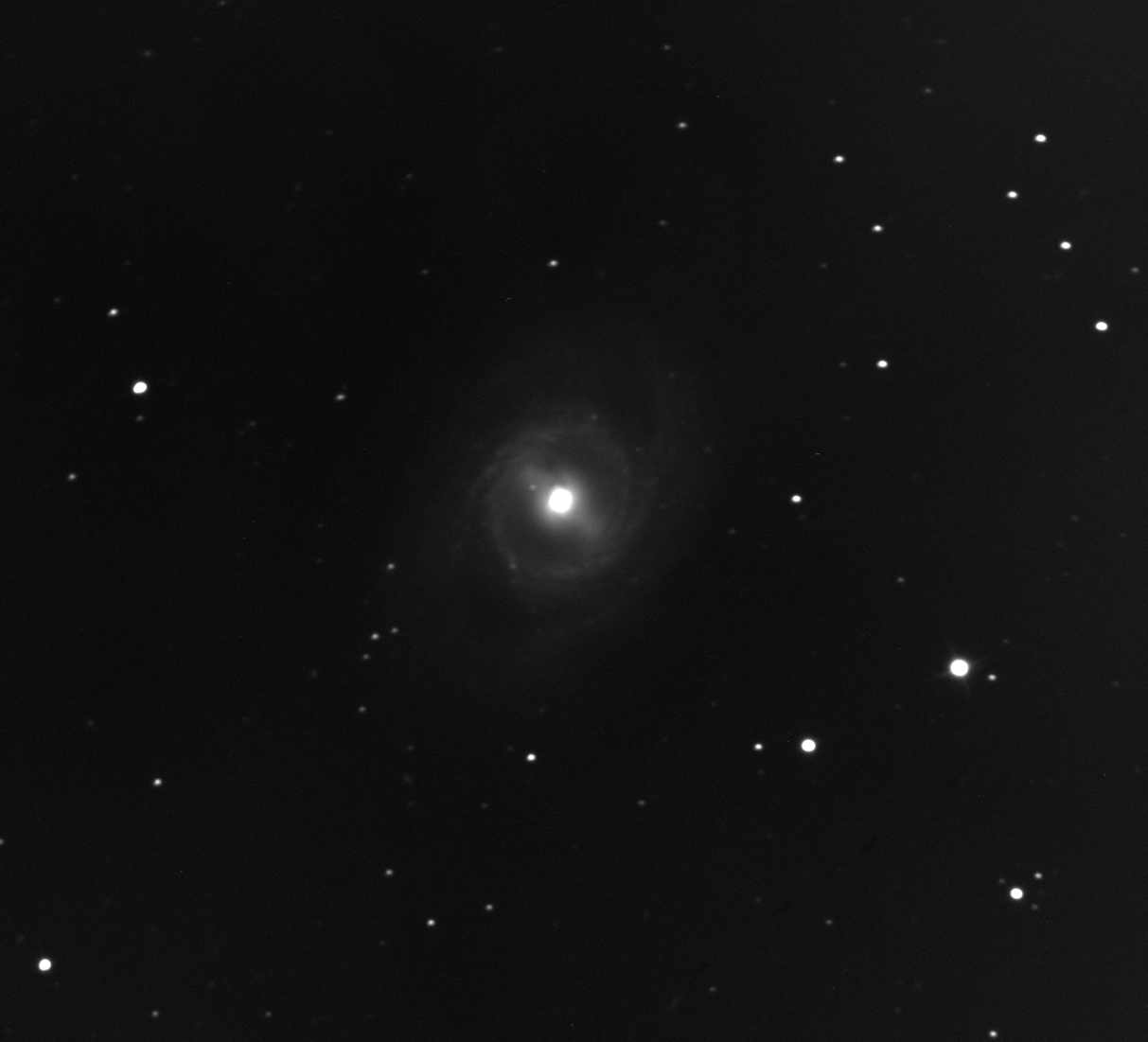
Barred spiral galaxy M-95. This is about 33 million light-years away and was discovered by Pierre Méchain in 1781.

M-96

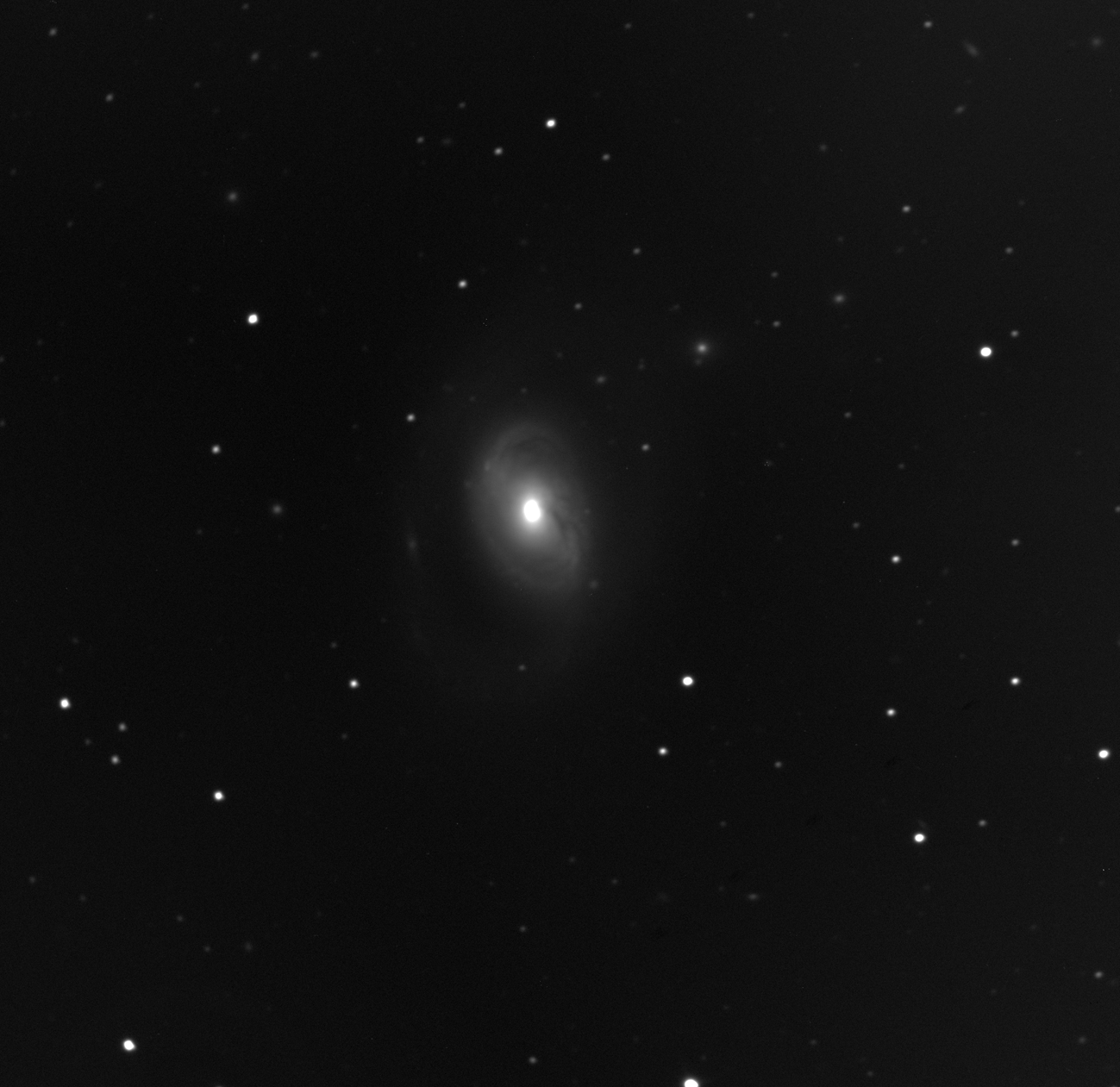
M-96, a spiral galaxy in Leo some 31 million light-years away.

M-105

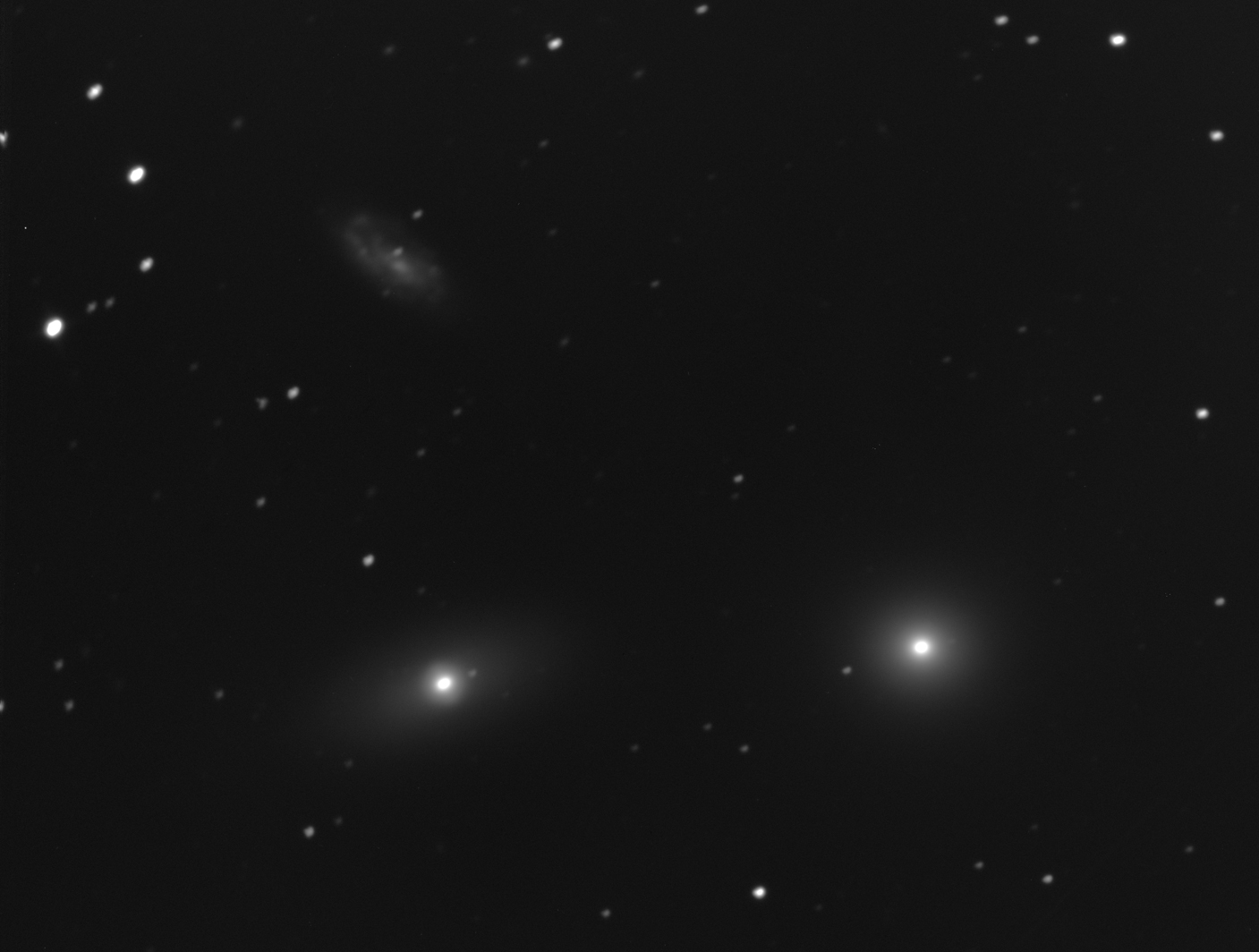
A galaxy trio: M-105, NGC 3384 and NGC 3389., all about 35 million light-years distant.

What follows is a two-image focus on Messier 87, a large elliptical galaxy in Virgo. This one has been in the news quite a bit for the recent work done with the Event Horizon Telescope to image the region immediately surrounding M-87’s central supermassive black hole. This black hole also is the cause for a large apparent superluminal jet (relativistic jet) of material being ejected from the galaxy at very high speeds. The first image is a wide field view. There are many other galaxies in the image, all part of the Virgo Cluster of galaxies. The second image is a close-up of M-87 showing the relativistic jet radiating out to the lower right of the galaxy’s core.

M-87 wide

Wide field view of M-87 and surrounding galactic neighbors.

M-87 detail

M-87 detail showing the relativistic jet.

Would you enjoy an annotated edition of the M-87 Region? Here it is!  As many galaxies as could be ID’ed have been labeled.

M-87 Annotated Region

M-87 Annotated Region: Click to see in larger format.

3C 273

3C_273 (star like object left-most of the central triangle of objects): one of the brighter nearby quasars in Virgo, this object holds the record for most distant object yet seen by the 0.7m telescope. It resides some 2.4 billion light years! As it is so luminous, it is not a difficult object to image, even with small telescopes, but is it fun to note that we are seeing such ancient light from the immediate surroundings of a black hole 2.4 billion light-years away!Can’t find it? Here it is again with markers:

3C_273