Lunar Occultation of Jupiter: 6 October 2026

This was the second occultation of the planet Jupiter within recent weeks, but the last one took place in broad daylight, much less spectacular to observe than this event which took place at nighttime. The one disadvantage was that “night” was at 4:25 in the morning for us here at Exeter, NH, USA. This made for a small audience…. myself, in a field, with a portable telescope, camera and a winter coat and hat. Portability in astrophotography is much easier than it used to be. This time around, a small refractor, a GoTo mount, a portable 12V power pack, and a DSLR were all that were needed.

Arriving at the scene, the view was already lovely: there, above the eastern horizon was Jupiter just beneath the Moon, about an hour away from the event itself. High in the sky to the south: Orion and Taurus. Rising with the Moon was Leo. The milky Way was sprawled across the sky. There were a couple of Great Horned Owls hooting in the nearby forest. Perfect!

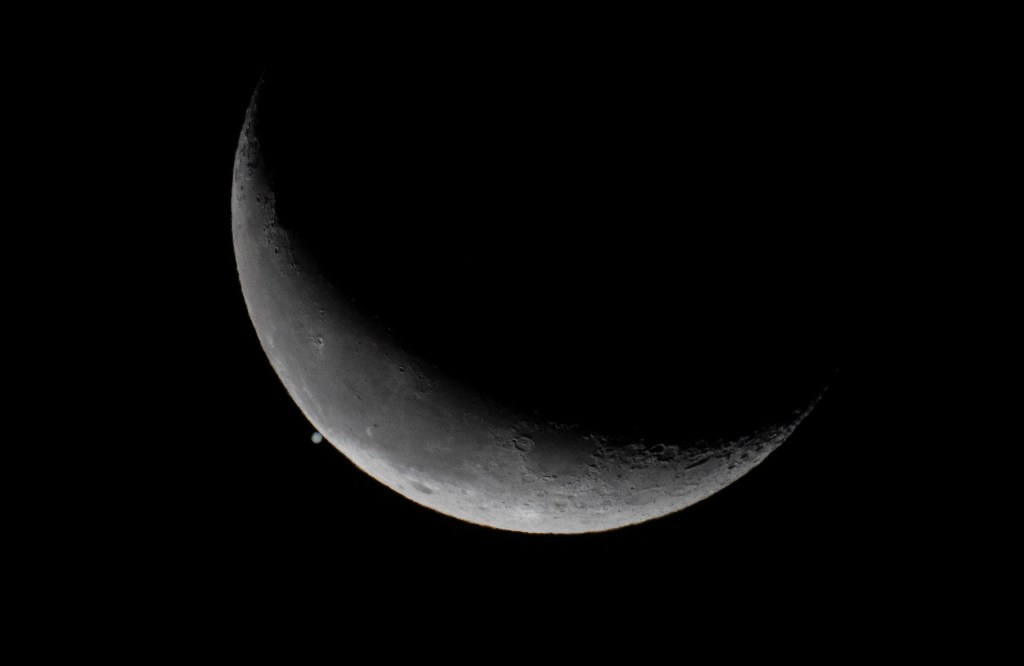
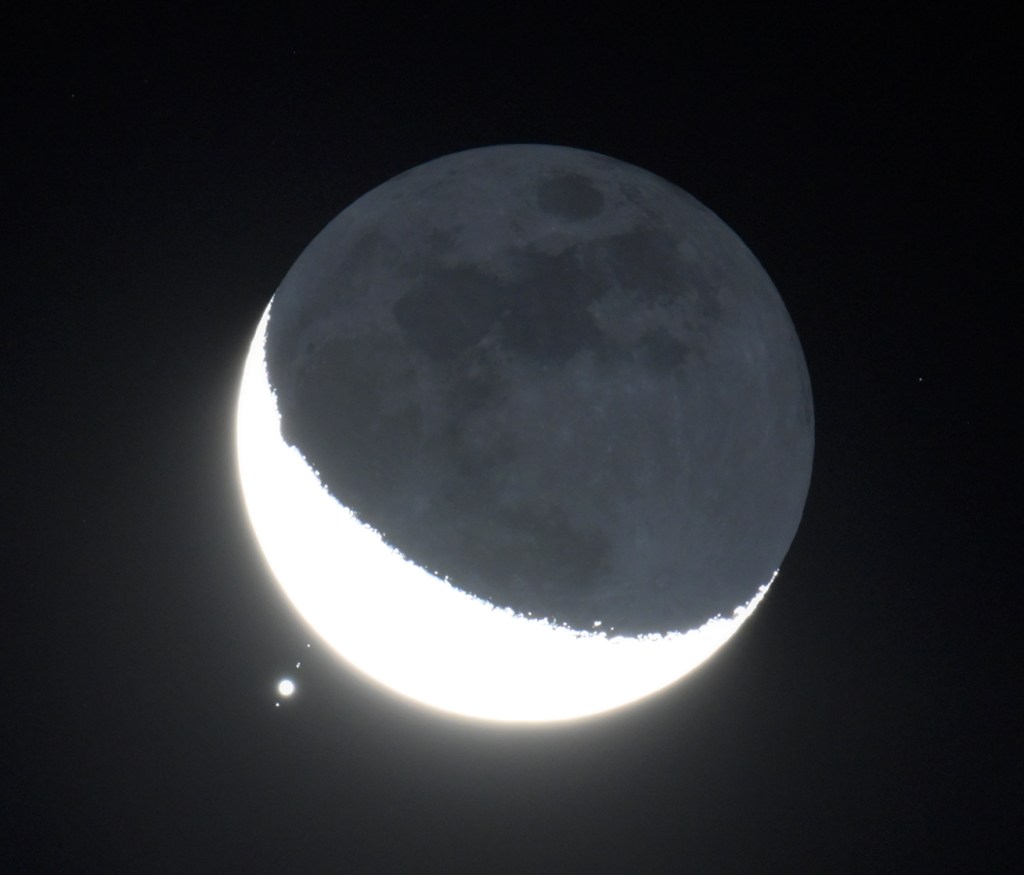
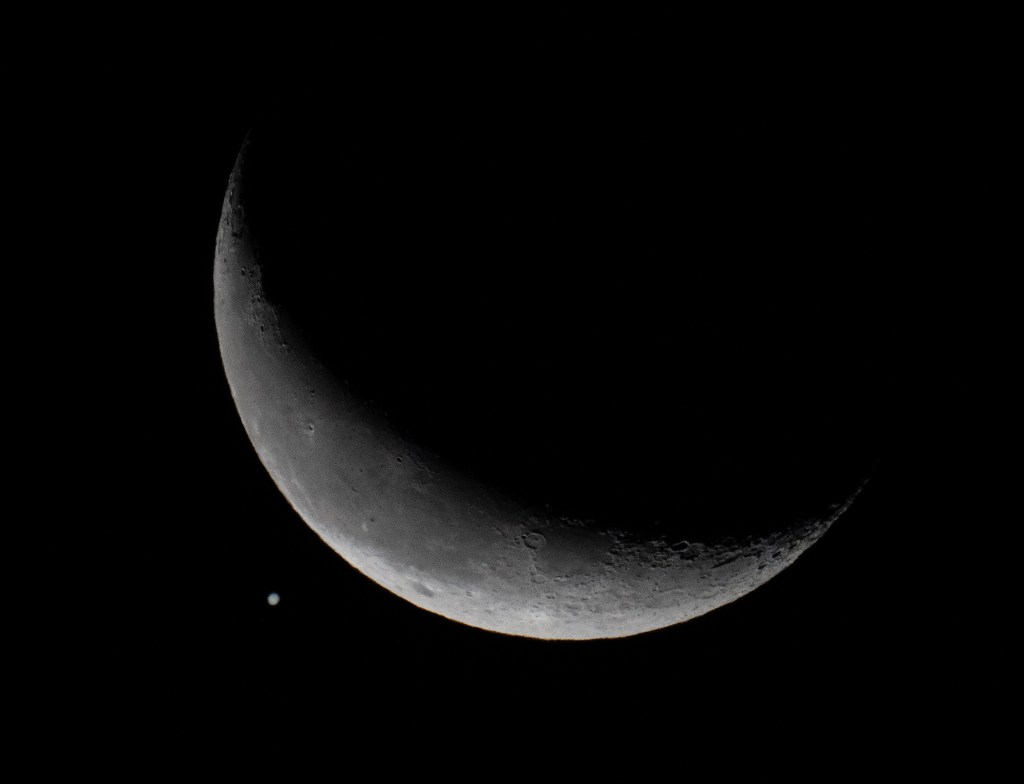
Perfect it was: seeing conditions were not absolutely the best, but they were good enough to spot the bright Galilean moons of Jupiter, and an occasional view of the major cloud bands on the planet. The Moon as a waining crescent gave a nice view of the craters and mountains that we usually don’t get to see in such a relief without being up early in the morning before sunrise. Like clockwork, the event unfolded nicely giving some good opportunity for images. Below are three:

An overexposed image to show off two neat things: The Earthshine from the Moon’s unilluminated side, and the four bright moons of Jupiter, Io, Ganymede, Europa and Callisto.

Two images exposed to show Jupiter as it approached occultation. The Moon is also well exposed. If you look carefully, one can just see the cloud bands on Jupiter.
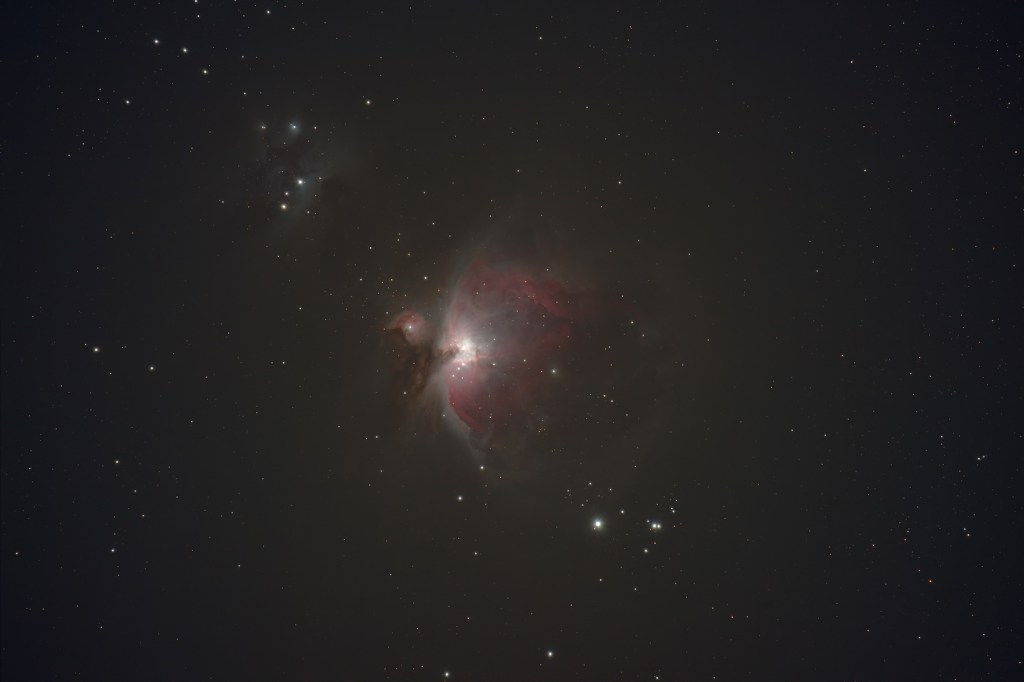
Once Jupiter was completely blocked by the Moon’s presence, being awake with stars in the sky was a real draw. I decided to spend some time gathering images of the favorite winter targets. In the case shown below, the much beloved Orion’s Nebula (Messier 42) was a good one. It was highest in the sky (culminating) and a bright enough target that a few minutes of exposure time would grab a good image.
Jupiter/Saturn Conjunction 21st December 2020

The date has come and gone, but the weather was the trickiest part of the event: we had a large cloudy set of systems across much of the northern portion of the USA, though we had almost exactly 30 minutes of clear skies here in Exeter, NH to see the conjunction in all its glory before the clouds then fog took over the evening.

Arrival at the observatory is something I just do, especially when there is an interesting or important event taking place. The day had been solidly overcast, but I was keeping watch on the NOAA GOES-East: Sector View site to see if any clear regions were headed our way. Sure enough, there was a parting in the clouds, about the width of Massachusetts, headed towards us from the southwest. I set up the camera and the telescope in the dome, pointing them both at the correct location… ready for that clear sky moment! Sure enough, the sky did clear!

Setup next to one of the observatory domes, the wide field view was lovely. With good vision, one could easily separate the two planets, Jupiter the brighter of the two, and Saturn the fainter. Here is a photo taken with Nikon D-810 and a AF-S Nikkor 1:3.5-5.6 28-300mm zoom lens, one of my favorite go-to travel lenses. The system was on a stable tripod and time-delay release was used on the shutter to prevent vibrations. The inset image is the telescopic view of the planet pair.

Moving inside the dome, I had the Takahashi FC-125 refractor setup with a Nikon D-810a at prime focus. This stem is very stable, driven on a Paramount Me and protected from the wind. Here are a couple of images taken through the telescope, one long exposure to see Jupiter’s and Saturn’s moons, and another to see some planetary detail. The seeing conditions were atrocious this evening, so no detail was really seen on Jupiter, alas. Saturn’s rings were readily visible, though.

Below is a long exposure image of the scene with all the objects labeled for identification. Those objects labeled “HIP #” are stars that happen to be in the field of view.

Below is an image from within the dome, a view looking along the telescope out the dome aperture where the conjunction was easily seen.  This photo was taken with an iPhone. The insert is the telescope’s view. You can also see the incoming clouds from the southwest which were headed to interfere with our observing plan in the very near future.

Not some 10 minutes later, this is what the observatory site looked like: a foggy mess. Only the first quarter moon was visible through the fog and clouds.